top of page

Yin Yoga vs Restorative Yoga for Relaxation: Which Path to Deep Rest is Yours?

  • Writer: Massoga® Massage Yoga
    Massoga® Massage Yoga
  • Aug 29
  • 12 min read

What if the key to melting that stubborn, deep-seated tension isn't more movement, but the courage to be completely still? You likely feel permanently "on", your mind racing even when your body is supposedly at rest, or perhaps you're weathering the heavy fog of adrenal fatigue that traditional massage just can't touch. It's exhausting to feel overwhelmed by choice when all you want is to feel held and nurtured. Understanding the nuance of yin yoga vs restorative yoga for relaxation is the first step toward reclaiming your internal peace and finding a sanctuary that truly serves your unique nervous system.

I promise that by the end of this exploration, you'll know exactly which practice offers the specific relief your body is craving. We will peel back the layers of these two gentle disciplines, exploring how Yin targets the deep connective tissues while Restorative focuses on total physiological surrender. This guide provides the clarity you need to transition from burnout into a state of deep presence, helping you choose the path that leads to genuine burnout recovery. Soften your shoulders. Breathe. Let's find your way home to yourself.

Table of Contents

Understanding the Nuance: Is it Yin or Restorative Yoga You Need?

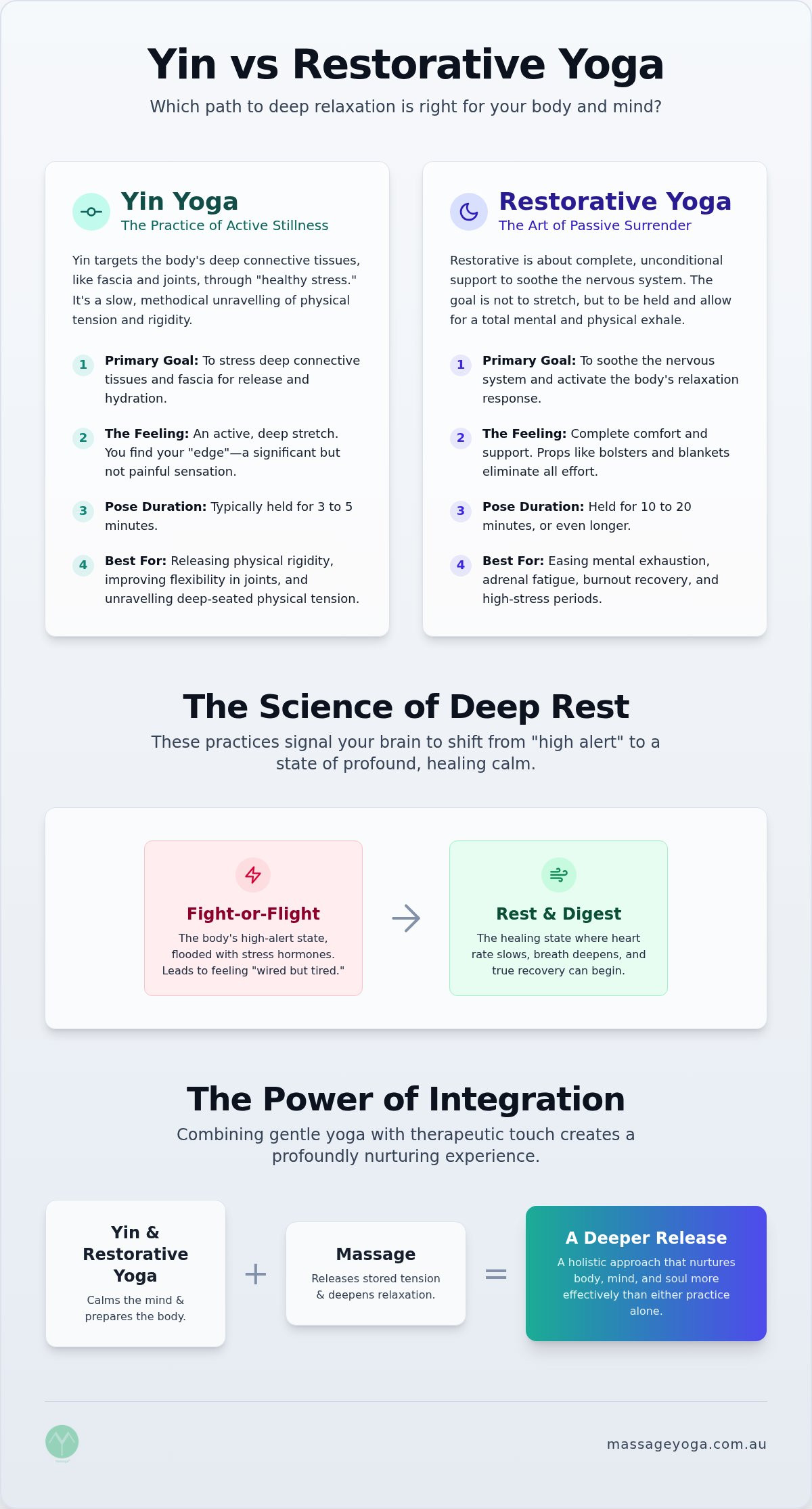
You carry the weight of everyone's expectations. You're the one who organises the chaos, yet your own internal landscape often feels like a storm that won't subside. When seeking relief, it's common to conflate different styles, assuming any "slow" class will do. However, the choice between yin yoga vs restorative yoga for relaxation depends entirely on what part of you is crying out for attention. Yin represents an "active" stillness, a deliberate leaning into the deep connective tissues and fascia. Restorative is a "passive" surrender, a total immersion in support designed specifically to soothe the nervous system. Both serve as a bridge, guiding you from the relentless pace of "doing" into the spaciousness of "being". It's about moving from a state of constant output to a state of receptive presence.

The Philosophy of Yin: Stressing the Tissue

Rooted in Taoist traditions, Yin yoga invites us to apply "healthy stress" to the body's deeper, less elastic layers. While most exercise targets the muscles through repetitive movement, Yin asks you to bypass the superficial to reach the bone and joint. You settle into postures for three to five minutes; a duration that allows the fascia to slowly hydrate and release. It's a practice of finding your "edge", that specific point where the sensation is significant but never sharp. This is the perfect antidote for those who feel physically rigid or "stuck" in their own skin. It's a slow, methodical unravelling of the physical armour you've built up over time. In a Yin practice, you might notice:

  • A focus on the lower body, specifically the hips, pelvis, and lower spine.

  • A gradual softening of the myofascial networks.

  • The development of mental fortitude through staying with sensation.

The Essence of Restorative: Supporting the Soul

If Yin is an unravelling, Restorative is a cradling. In this practice, the goal is not to stretch or stress the body but to be completely, unconditionally supported. You'll find yourself surrounded by bolsters, blankets, and blocks, ensuring every limb feels safe and held by the earth. These postures are often held for up to twenty minutes, allowing for a total mental exhale that most of us rarely experience. It acts as a soft, weighted blanket for an overstimulated mind, providing the physiological safety required for the brain to stop scanning for threats. Choosing between yin yoga vs restorative yoga for relaxation often comes down to whether you need to release physical density or mental exhaustion. This is where the nervous system finds its true reset, moving you away from the "on" switch and into a state of profound, nurtured quiet.

The Science of Deep Rest: How These Practices Reset Your Nervous System

The parasympathetic nervous system is the body’s "rest and digest" mode, acting as the essential biological counterweight to the frantic energy of your working day. When you settle into long-held postures, you're doing more than just sitting still; you're sending a physical signal to the brain that the "threat" of the day is finally over. This shift is crucial when weighing the benefits of yin yoga vs restorative yoga for relaxation, as both styles create the necessary space for this neurological transition to occur. Your heart rate slows. Your breath deepens. The internal alarm system finally clicks off.

Your fascia, the intricate web of connective tissue that wraps around every muscle and organ, is a silent recorder of your emotional history. It's often where we store the tension of unspoken words or the rigidity of chronic overwhelm. Yin yoga specifically targets this network, using gentle, persistent pressure to release stored tension that traditional movement might miss. By softening these deep layers, you're not just improving flexibility; you're facilitating a profound emotional unburdening. It requires a level of sensory immersion that allows you to transition from a busy, external focus into a state of quiet, internal presence.

Moving from Fight-or-Flight to Stillness

Living in a state of chronic stress keeps your body in a permanent state of high alert, a physiological "on" switch that never quite resets. This constant fight-or-flight response floods your system with cortisol, leading to that familiar sense of being wired but tired. As you explore the science of yin yoga vs restorative yoga for relaxation, you begin to see that both practices are designed to lower the heart rate and calm the mind. Intentional stillness provides the immediate relief your adrenal glands are begging for. You can explore more about these transformative benefits in our guide on The Art of Deep Rest.

The Role of Sensory Directives in Healing

Guided cues act as anchors for a wandering, anxious mind, providing a gentle path back to the present moment. In a trauma-sensitive environment, the language used is carefully chosen to empower you, offering invitations rather than commands to ensure you feel safe within your own body. This sense of internal safety is amplified when we introduce the Massoga® methodology. By incorporating hands-on massage into Yin poses, the relaxation response is accelerated through the healing power of touch. It’s a sensory immersion that bridges the gap between physical release and mental clarity. If you're ready to experience this level of care, you might consider how to begin your journey to deep rest.

Yin vs Restorative Yoga for Relaxation: A Guide

Choosing between yin yoga vs restorative yoga for relaxation is an act of listening to what your body is whispering in this very moment. While both practices invite you to slow down, the internal experience differs significantly. Yin offers a "mild discomfort", a sweet, dull ache as you lean into the resistance of your connective tissues. It's a practice of edge-finding. In contrast, Restorative yoga is defined by "total comfort". Every part of you is supported by props so that the body feels no need to grip or protect itself. One asks you to sit with sensation; the other asks you to dissolve into softness.

The physical targets of these disciplines are distinct. Yin goes deep, focusing on the plastic-like nature of ligaments, joints, and fascia. Restorative yoga stays gentle, aiming its focus directly at the entire nervous system to elicit a healing response. This difference affects your perception of time. In a Yin pose held for five minutes, time can feel stretched and spacious as you observe the sensations uncurling. In a Restorative pose held for twenty minutes, time often disappears entirely. You might drift into a state between waking and sleep, a liminal space where true restoration occurs.

When to Choose Yin Yoga

Yin is the ideal sanctuary when you feel physically tight or "stuck", as if your body has become a cage for stagnant energy. It's best suited for days when you have a moderate amount of mental energy to sit with physical sensation without feeling overwhelmed. Because it requires a level of focus to remain still amidst the "juicy" stretch of a pose, Yin act as a powerful preparation for deeper meditative states. It helps you build the capacity to stay present with whatever arises, making it a transformative tool for those who feel their physical rigidity is mirroring a mental block.

When to Choose Restorative Yoga

Choose Restorative yoga when you're in the depths of exhaustion or navigating the heavy weight of adrenal fatigue. When your goal is purely emotional release and mental quietude, this practice provides the necessary "soft blanket" for your soul. It's the primary choice for those who feel they have nothing left to give and simply need to be held. By removing all physical effort, you create the safety required for a total mental exhale. This approach is central to Healing Through Stillness, where the focus is on nurturing your system back to a state of balance and peace. Use this path when your nervous system feels frayed and you need to move from a state of survival back into a state of grace.

Yin yoga vs restorative yoga for relaxation

Creating Your Sanctuary: Preparing for a Restorative Experience

Before you even step onto your mat, the work of unravelling begins. Your physical environment acts as a direct communication line to your nervous system, either whispering of safety or shouting of unfinished tasks. When choosing between yin yoga vs restorative yoga for relaxation, the success of your practice often hinges on the container you create. A true sanctuary requires more than just floor space; it demands a deliberate curation of sensory cues that signal to your brain that the day's demands have finally ceased. Dim the lights. Close the door. Let the outside world wait.

Preparation is a ritual of self-care. Start by silencing your digital world at least 30 minutes before you begin, allowing the mental noise of notifications to fade into the background. Your physical comfort is the highest priority, so gather props that enhance the sensation of being held. Bolsters, thick blankets, and weighted eye pillows are essential tools for grounding. If you don't own professional props, your home is already full of alternatives. A rolled-up quilt can replace a bolster, and a stack of firm cushions provides the same support as a yoga block. Consider these elements for your space:

  • Warmth: Your body temperature drops during deep rest, so wear thick socks and keep a spare blanket nearby.

  • Lighting: Use salt lamps, candles, or low-wattage warm bulbs to mimic the soft hues of dusk.

  • Scent: Essential oils like lavender or sandalwood can act as a Pavlovian trigger for immediate softening.

  • Silence: If your environment is noisy, a playlist of soft, ambient sound or white noise can create a necessary barrier.

The Mindset of Surrender

Entering your practice requires a conscious shift in intention. The ideal mental state for entering a restorative session is one of soft, receptive waiting, much like a quiet pool of water undisturbed by the ripples of the day. Before you settle into your first pose, take five slow, deep breaths into your belly, feeling the ribs expand and the shoulders drop. This simple act begins the softening process. Shift your focus away from "achieving" a certain stretch and move toward "receiving" the support of the earth. You're not here to do; you're here to be.

The Practicalities of Home Practice

Finding a "no-interruptions" zone can be challenging in a busy Australian household, but it's vital for a deep reset. Communicate your needs to those you live with, explaining that this time is for your recovery. Staying warm is perhaps the most overlooked practical detail; a chilled body will instinctively grip, preventing the fascia from releasing. By ensuring your physical needs are met with blankets and layers, you allow your nervous system to remain in a state of profound, nurtured quiet. This preparation turns a simple floor space into a high-end sanctuary for the soul.

The Massoga® Difference: Why We Integrate Yin, Restorative, and Massage

While many guides suggest a binary choice between yin yoga vs restorative yoga for relaxation, true transformation often lies in the synergy between them. You don't have to choose between the deep physical unravelling of Yin and the profound mental surrender of Restorative. The Massoga® Massage Yoga methodology, developed by Wallis Murphy-Munn, thoughtfully integrates these disciplines into a singular, evolved path to wellness. By blending Yin poses with hands-on massage, we create a multi-layered experience that addresses both the density of the fascia and the fragility of a frayed nervous system. It's a transition from simply "doing" yoga to being completely held in a state of grace.

For many women facing burnout, even a quiet group class can feel overstimulating. The presence of others, the subtle sounds of a shared room, or the internal pressure to "perform" stillness can inadvertently keep the nervous system on alert. This is why private sessions, such as One on One Massoga® Treatments, offer such a profound sanctuary. They provide a controlled, trauma-sensitive environment where the focus is entirely on your internal release. View this deep rest not as a fleeting luxury, but as essential maintenance for your soul. It is the foundation upon which your resilience is rebuilt.

Massage Yoga: The Ultimate Nervous System Reset

Hands-on touch acts as a powerful catalyst, deepening the release found in traditional poses. When a skilled practitioner applies gentle, intentional pressure during a Yin hold, it signals to your body that it is safe to soften further than it could alone. The practitioner becomes a nurturing guide, anchoring you in the present moment and facilitating a level of immersion that leads to a genuine sensory reset. This integrated approach is the heartbeat of our Magnetic Island Retreats, where the environment and the methodology work in harmony to restore your spirit.

Taking the Next Step Toward Rest

You can begin this journey toward recovery without the stress of travel. Booking a private Massoga® at Home session allows you to create a sanctuary in your own living space, tailored specifically to your physical and emotional needs. Regular restorative practice is a vital tool for burnout prevention, acting as a consistent reset for your adrenal system. It's time to stop waiting for a crisis to justify your recovery. Take a soft exhale. Prioritise your rest. Your body has been waiting for this invitation for a long time.

Reclaiming Your State of Being

Choosing between yin yoga vs restorative yoga for relaxation is no longer a source of overwhelm; it's a doorway to your recovery. You now understand that Yin offers a path to physical unravelling, while Restorative provides the sanctuary your nervous system needs to feel safe. Through the Massoga® Integrated Methodology, these paths converge, offering a blend of Yin poses and hands-on massage that facilitates a deeper surrender than either could achieve alone.

Whether you seek luxury sanctuary experiences or trauma-sensitive private care, the goal is to move from the noise of doing into the quiet of being. This is your essential maintenance, the foundation of your resilience and the antidote to burnout. Your body has been holding the weight of the world for long enough. It's time to let the earth hold you instead.

Step into the stillness. Your journey home to yourself begins with a single, supported breath.

Frequently Asked Questions

What exactly is the main difference between Yin and Restorative yoga?

The main difference lies in the intention and physical target of the practice. Yin yoga is an "active" form of stillness that uses gravity to stress the deep connective tissues and fascia. Restorative yoga is a "passive" surrender where the body is entirely supported by props to soothe the nervous system. Understanding yin yoga vs restorative yoga for relaxation helps you choose between mild physical sensation and total physiological comfort for a profound mental exhale.

I’m not flexible at all; can I still do Yin yoga for relaxation?

You don't need to be flexible to experience the benefits of Yin yoga. In fact, Yin is designed to improve your natural range of motion by gently hydrating the fascia over time. The practice isn't about achieving a specific shape but about finding your personal "edge" of sensation. By staying still for several minutes, you allow your body to soften at its own pace, making it highly accessible for all levels of experience and physical ability.

How long do I need to hold the poses to feel the benefits?

The duration of a hold depends on the style you're practising. In Yin yoga, poses are typically held for three to five minutes to reach the deeper connective tissues. Restorative yoga poses can last anywhere from five to twenty minutes, providing the time necessary for the nervous system to shift into a "rest and digest" mode. These longer durations are essential for signalling to the brain that it is finally safe to release chronic, deep-seated tension.

Do I need expensive props to practise restorative yoga at home?

You certainly don't need professional equipment to create a sanctuary at home. While bolsters and blocks are helpful, everyday household items like rolled-up quilts, firm lounge cushions, and thick bath towels provide excellent support. The goal is to ensure your body feels completely held so the mind can surrender. Using what you have allows you to begin your journey toward deep rest without the stress of additional costs or a complex, overwhelming setup.

Can these practices help with chronic stress and burnout?

These practices are specifically designed to address the physical and emotional toll of chronic stress and burnout. By intentionally slowing down, you move your body out of a permanent "fight-or-flight" state and into a restorative parasympathetic mode. Understanding the nuance of yin yoga vs restorative yoga for relaxation helps you choose the right tool for your recovery. Regular practice can lower cortisol levels, improve sleep quality, and restore your internal sense of balance and peace.

Is Yin yoga safe if I have a sensitive nervous system or trauma history?

Yin yoga is safe, but it's vital to choose a practitioner who understands trauma-sensitive care. Because Yin can bring up intense physical sensations or emotions, a supportive environment is necessary for safety. At Massoga®, our methodology prioritises your internal well-being through gentle, guided cues and private treatments. This trauma-sensitive approach ensures that you never feel overwhelmed, allowing you to process and release stored tension at a pace that feels completely nurtured, spacious, and secure.

How often should I practise to see a difference in my stress levels?

Consistency is more important than the length of any single session. Practising once or twice a week can lead to a noticeable reduction in your overall stress levels and improved mental clarity. Even a twenty-minute restorative session at home can act as a powerful circuit breaker for a busy week. Over time, these moments of stillness build your capacity for resilience, making it easier to navigate the demands of daily life with a renewed sense of presence.

What is the best time of day to practise for deep relaxation?

The early evening or just before bed is often the best time to practise for deep relaxation. Engaging in a restorative session during these hours helps your body transition from the high-energy output of the day into a state prepared for sleep. By dimming the lights and using sensory cues like essential oils, you signal to your brain that the "threat" of work is over. This ritual facilitates a smoother, more gentle descent into restorative rest.


Comments


Written by Wallis Murphy-Munn

Wallis Murphy-Munn is the founder of Massoga®, a unique practice that combines the therapeutic benefits of massage with the restorative elements of Yin Yoga.


Her hands-on teaching approach has led to deeper relaxation for her students, inspiring the creation of Massoga®.


In addition to her practice, Wallis enjoys writing blog articles to share her insights, advocating for the importance of human touch and simple connections in an increasingly isolated world.

14.png

About

Yoga Retreats

Other Services 

  • Instagram
  • Facebook
  • LinkedIn

We acknowledge the traditional owners of the land in all the regions of the beautiful countries we travel to and experience on retreat. The custodians of Kulin Nation, in the regions of the Woiworung, Boonwurrung and Wathaurong People. The custodians of the Yunbenun of the Wulgurukaba People. We acknowledge their Ancestors past, present and future who nurtured and cared for Country for tens of thousands of years.

© 2025 Massoga® Massage Yoga | Website by Insight Culture

bottom of page