top of page

How to Teach Your Body to Switch Off: A Guide to Rest

Writer: Massoga® Massage Yoga
Massoga® Massage Yoga
4 days ago
12 min read

You lie in the dark at 2 am, your mind racing through tomorrow's tasks while a low hum of anxiety vibrates in your chest. It's a familiar, exhausting rhythm that many of us recognise all too well. Despite Australia's legislated Right to Disconnect, the internal noise often refuses to honour the clock. You want to rest, but your body remains braced for a threat that never arrives. Learning how to teach your body to switch off when you feel permanently on isn't a matter of willpower or mental discipline. It's a physiological shift. It requires a gentle, soulful invitation to move from hyperarousal into a state of somatic safety.

Soft limbs. A quietened pulse. We understand the guilt that often comes with stillness and the frustration of a mind that won't settle. This guide promises to lead you toward a quiet mind and a body that feels heavy, soft, and truly relaxed. You'll discover how integrated restorative practices can help you move past the caffeine-driven push and into a state of sustainable energy. We will explore the science of nervous system regulation and the profound relief found in supported surrender, helping you transition from the busyness of life into a state of deep, restorative presence.

Table of Contents

The Anatomy of Feeling "Permanently On"

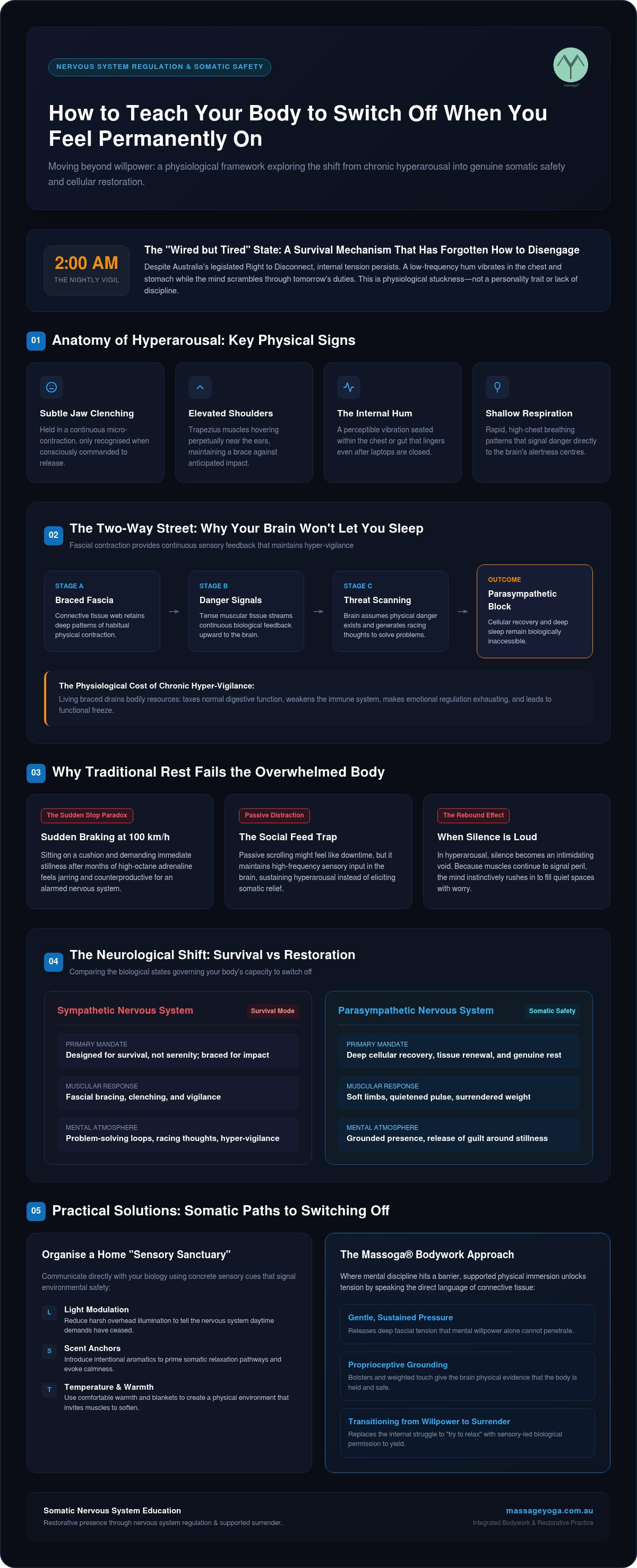
Imagine a low-frequency vibration, a physical hum that sits deep within your chest or stomach. It doesn't matter if the laptop is closed or the house is quiet; the hum remains. You might notice your shoulders hovering near your ears or a subtle clenching in your jaw that you only recognise when you consciously try to let go. This is the hallmark of being stuck in the sympathetic nervous system, the branch of your biology designed for survival, not for serenity. When this system dominates, your body is effectively braced for impact, even when you are physically safe.

Hyperarousal is a state of physiological stuckness rather than a personality trait. It is a biological survival mechanism that has forgotten how to disengage. For many high-achieving Australians, this manifests as the "wired but tired" paradox. You are physically exhausted, yet your nervous system is still sprinting at full capacity. Understanding how to teach your body to switch off when you feel permanently on begins with acknowledging that your body is currently communicating a signal of "danger" to your brain. Until that signal changes, the mind will continue to scan for problems to solve.

Why Your Brain Won’t Let You Sleep

The relationship between your mind and body is a two-way street. While we often blame our racing thoughts for our lack of sleep, the physical tension in your body is often the primary driver of those thoughts. Your fascia, the intricate web of connective tissue that weaves through your entire form, can hold onto deep patterns of contraction. When your muscles are perpetually braced, they send a constant stream of sensory feedback to the brain. Your brain stays alert because it believes the body is still under threat. This makes it almost impossible to drop into the parasympathetic nervous system, which is the only state where true cellular recovery and deep sleep occur.

The Cost of Constant Hyper-Vigilance

Living in a state of perpetual "on" is vastly different from simply being busy. You can be busy and still feel grounded; hyper-vigilance, however, erodes your internal resources from the inside out. Over time, this chronic arousal taxes your digestion, weakens your immunity, and makes emotional regulation feel like an exhausting chore. It is the reason you might feel irritable over small inconveniences or find it hard to truly connect with the people around you. If you've ever wondered Why You’re Still Tired After Rest, it's likely because your body hasn't actually left the battlefield. True rest requires the body to feel somatically safe enough to finally soften its guard and surrender its weight.

Why Traditional Rest Often Fails the Overwhelmed Body

You've likely tried the traditional advice. You sit on a cushion, close your eyes, and wait for the peace to arrive. Instead, you're met with a deafening internal noise. This is why many people struggle when learning how to teach your body to switch off when you feel permanently on. For a nervous system that has been running on high-octane adrenaline for months, a sudden stop feels like slamming on the brakes at a hundred kilometres an hour. It's jarring, unsettling, and often counterproductive.

True recovery doesn't happen through distraction. Scrolling through a social feed might feel like a break, but it keeps the brain in a state of high-frequency input. To reach the parasympathetic nervous system, you need to evoke the relaxation response through somatic cues that tell the body it is safe to stop. Without this bridge, you remain in a state of functional freeze. You are physically still, but internally you are still vibrating with the tension of the day.

When Silence is Loud: The Challenge of Stillness

When you are stuck in hyperarousal, silence isn't peaceful. It's a void that your brain feels compelled to fill with worry. This rebound effect happens because the mind is still scanning for the danger your tight muscles are reporting. A sensory-led approach is different. When the body feels physically supported and held by bolsters or weighted touch, it receives the proprioceptive feedback needed to signal safety. It is a transition from a mental command to a physical permission. Understanding how to teach your body to switch off when you feel permanently on requires this shift from the mind to the skin and bones.

The Myth of the Quick Fix Holiday

We often pin our hopes on a fortnight in the sun, only to find that the physical hum follows us to the beach. A holiday is a change of scenery, but it isn't necessarily a change of state. Learning the art of prioritising rest as a daily, integrated skill is what creates lasting change. It's about building a capacity for softness within your ordinary life. If you feel the weight of the world on your shoulders, you might find that a more structured path to surrender is what your system is actually craving. You can begin your journey toward deeper rest today by choosing to listen to those physical cues.

Teaching the Body to Soften: Somatic Path to Switching Off

The mind is a relentless narrator, but the body speaks in the language of sensation. When you are learning how to teach your body to switch off when you feel permanently on, you must stop trying to argue with your thoughts and start communicating with your nervous system. Somatic safety is the foundation of this dialogue. It is the process of providing your body with enough physical evidence of security that it can finally choose to downregulate. This isn't something you can think your way into; it's something you must feel your way into.

Unlike traditional exercise-based yoga that focuses on movement and heat, restorative Yin yoga prioritises stillness and cooling. While some might suggest high-intensity activity to "burn off" stress, research from the American Psychological Association on how chronic stress affects the body shows that persistent arousal keeps the musculoskeletal system in a state of guarding. Adding more intensity can often backfire, spiking cortisol when you most need it to drop. Instead, we use gentle, sustained pressure to invite the fascia to hydrate and release, acting as a physical "off" switch for the bracing reflex.

Proprioception and Safety

Grounding begins with proprioception, which is your brain's ability to understand where your body is in space. When you are overwhelmed, your sense of boundary can feel frayed or non-existent. Using props like heavy bolsters, firm blocks, and weighted blankets creates clear physical boundaries that help the nervous system feel contained. When you allow these physical supports to take your full weight, your muscles are finally granted permission to quit their job of holding you up. This physical surrender is the first step in how to teach your body to switch off when you feel permanently on, moving you from a state of bracing to one of being held. For those looking to integrate more of these moments into their routine, you can find out more about professional treatments that promote sensory focus and relaxation.

The most effective path to rest often involves a combination of disciplines that address the body's needs from multiple angles. By pairing the long, passive holds of restorative yoga with targeted remedial massage, we create a powerful synergy that bypasses the critical mind entirely. This massage and yoga combined approach allows the therapist's hands to find the specific areas where you are still "on," gently coaxing the tissue into a state of immersion. It is a soulful invitation to let go, moving you from the noise of the day into a deep, wordless presence where true healing begins.

How to teach your body to switch off when you feel permanently on.

Practical Techniques to Organise Your Own Recovery

Organising your recovery is a conscious act of reclaiming your internal space. With 68% of professionals reporting difficulty disconnecting from work tasks outside of hours, finding how to teach your body to switch off when you feel permanently on has never been more critical. True rest is not a passive event; it is an active curation of your environment. Create a sensory sanctuary by lowering the lighting to a warm, amber glow. Introduce a grounding scent like cedarwood or sandalwood. Ensure your room is cool, as a drop in core body temperature is a primary biological cue for the brain to begin its descent into sleep.

The transition from work to home requires an intentional ritual to act as a circuit breaker. For the busy Australian, a "Five-Minute Soften" can provide the necessary pause. Upon arriving home, change your clothes immediately to signal a shift in your identity. Lie on the floor with a folded blanket under your head. Close your eyes and notice where you are still bracing against the day. Use weight, such as a heavy wheat bag on your pelvis, to provide the proprioceptive feedback your nervous system needs to feel secure.

Step-by-Step: The Nightly System Reset

Resetting your system before bed involves a methodical reduction of sensory input. This process helps your biology shift from a state of vigilance to one of surrender. Follow these steps to prepare your body for deep rest:

  • Temperature regulation: Use a warm bath to draw heat to the surface, followed by a cool room to help your core temperature drop.

  • Gentle inversion: Spend five minutes with your legs up the wall to settle your heart rate and encourage a shift into the rest-and-digest state.

  • Sensory withdrawal: Minimise input by using an eye pillow or earplugs to create a quiet, dark cocoon for your senses.

  • Diaphragmatic breathing: Focus on breathing deep into the belly, ensuring the exhale is longer than the inhale to trigger the vagus nerve.

Mindful Boundaries in a Digital World

Protecting your peace requires firm boundaries in a digital world. Organise a digital sunset by turning off all screens at least 90 minutes before bed to protect your melatonin production. This is a time to practise the power of "no" to the extra evening task. Instead, immerse yourself in a mundane ritual, such as preparing a cup of herbal tea. Notice the weight of the ceramic and the scent of the steam. This presence is a vital part of how to teach your body to switch off when you feel permanently on, anchoring you in the now.

The Massoga® Experience: A Sanctuary for the "Permanently On"

Massoga® was born from the understanding that some bodies cannot simply "relax" on command. It's a proprietary modality, founded in 2016 by Wallis Murphy-Munn, designed specifically for those whose nervous systems are locked in high gear. While previous sections explored the science of hyperarousal, the Massoga® experience is where that theory becomes a lived sensation of relief. It's the practical answer to how to teach your body to switch off when you feel permanently on. By moving away from the performance-based nature of traditional fitness, we create a space where your only job is to exist and be supported.

The practice is deeply rooted in trauma-sensitive principles, ensuring every touch and every posture feels safe and predictable. Whether you join a Luxury Massoga® Retreat or choose the quiet intimacy of Massoga® at Home, the focus remains on your internal well-being. This isn't about how far you can stretch; it's about how deeply you can surrender. Soft limbs. A quietened pulse. The physical "hum" finally begins to fade.

Why Hands-On Support Changes Everything

The Massoga® difference lies in the seamless integration of remedial massage delivered while you are resting in floor-based Yin postures. In a typical restorative session, you might still find your mind scanning for tasks; however, when a skilled practitioner applies targeted pressure to your specific myofascial lines, the body receives a direct cue to downregulate. This hands-on support bypasses the mental chatter and speaks straight to the deep connective tissue. It's a profound experience for the woman who spends her week looking after everyone else. Finally, you are the one being held, allowing your bracing reflex to dissolve under the warmth of professional, nurturing touch.

Your Invitation to Surrender

Wellness shouldn't be another item on your to-do list that requires effort. Our sessions are designed to remove the "work" from bodywork. By choosing a path of stillness, you are making a radical choice to prioritise your own nervous system over the noise of the world. Choosing this path is the ultimate lesson in how to teach your body to switch off when you feel permanently on, replacing chronic tension with a heavy, restorative calm. From the lush landscapes of Magnetic Island to the comfort of your own living room with One on One Massoga® Treatments, the sanctuary is ready for you. It's time to trade the caffeine-driven push for a state of deep, wordless presence.

Embrace the Softness of True Surrender

Restoring your nervous system is a journey of returning to the body. You've discovered that switching off is a somatic skill rather than a mental command, requiring a bridge between high-gear arousal and deep recovery. By prioritising somatic safety and integrated practices, you can finally move beyond the "wired but tired" cycle. Understanding how to teach your body to switch off when you feel permanently on is the first step toward reclaiming your energy and emotional ease.

Whether you seek the total immersion of our luxury retreats in the Otways and Magnetic Island, or the intimate care of trauma-sensitive, one-on-one treatments, the invitation remains the same. You are allowed to be held. You are allowed to let go. Our expert-led bodywork is designed to meet you exactly where you are, providing the specialised, integrated massage and yoga your system craves.

Take a slow breath. Soften your shoulders. Your sanctuary is waiting, and your body is ready to finally come home to itself.

Frequently Asked Questions

How do I know if my nervous system is stuck in "on" mode?

You'll recognise the "on" mode through persistent physical cues like a tight jaw, shallow chest breathing, or a constant "hum" in your stomach. It's the feeling of being braced for a threat that isn't there. Your mind scans for problems while your body refuses to settle even in bed. These are clear symptoms of sympathetic dominance, where the nervous system has lost its natural ability to downregulate into a state of safety, stillness, and repair.

Can I teach myself to switch off, or do I need professional help?

You can certainly implement daily rituals at home, but professional support often provides the necessary "bridge" to deeper rest. When you're learning how to teach your body to switch off when you feel permanently on, the presence of a skilled practitioner helps bypass the critical mind. Integrated treatments provide the physical evidence of safety that the brain requires to finally release long-held patterns of tension, hyper-vigilance, and muscular bracing.

Why does my heart race when I try to meditate or sit still?

This is often a "rebound effect" where the sudden removal of distraction makes the internal noise feel louder. For a dysregulated system, stillness can feel threatening rather than peaceful. Your heart races because the body is still stuck in a survival response. Instead of forcing silent meditation, a somatic approach using props and touch can signal safety to the heart, allowing your pulse to settle naturally through physical support and surrender.

What is the difference between Yin yoga and restorative yoga for stress?

Yin yoga focuses on the deep connective tissues and fascia through passive, long-held floor postures. Restorative yoga aims for total physical support with no stretch at all. While both are calming, Yin provides a gentle, sustained pressure that helps release the physical bracing often found in the "permanently on" state. Massoga® specifically utilises these Yin principles, pairing them with massage to reach the deep, wordless layers of the nervous system.

How long does it take to reset a dysregulated nervous system?

Resetting a dysregulated system is not an overnight event; it is a gradual process of building somatic capacity. While a single Massoga® session can provide immediate relief, long-term regulation usually requires consistent practice over several weeks or months. Every moment of true rest you experience acts as a new data point for your brain, slowly teaching it that it is safe to stay in the rest-and-digest state for longer periods of time.

Is massage or yoga better for someone who is permanently stressed?

Neither is necessarily "better," but they are profoundly more effective when combined. Massage provides the external sensory input of safety and release, while restorative yoga allows the body to be held in stillness. Massoga® integrates these two disciplines because the combination addresses both the musculoskeletal bracing and the autonomic nervous system simultaneously. This integrated approach is often the most efficient way to unlock a body that feels permanently stuck in a state of stress.

What should I do if I feel guilty for taking time to rest?

Guilt is a common response for those who equate their value with productivity. Try to reframe rest as a physiological requirement rather than a luxury. When you are learning how to teach your body to switch off when you feel permanently on, you are actually restoring your capacity to show up for others. Rest is the fuel that allows for sustainable energy, moving you away from the caffeine-driven push and toward a more grounded, present life.

Can I do Massoga® if I have never done yoga before?

Absolutely. Massoga® is designed to be accessible to everyone, regardless of their yoga experience. Because the practice is entirely floor-based and uses extensive props like bolsters and blankets, there is no need for flexibility or balance. Our practitioners provide all the necessary support, making it an ideal entry point for anyone seeking deep rest. It's a nurturing, trauma-sensitive environment where the focus is entirely on your internal state of surrender and peace.


Comments


Written by Wallis Murphy-Munn

Wallis Murphy-Munn is the founder of Massoga®, a unique practice that combines the therapeutic benefits of massage with the restorative elements of Yin Yoga.


Her hands-on teaching approach has led to deeper relaxation for her students, inspiring the creation of Massoga®.


In addition to her practice, Wallis enjoys writing blog articles to share her insights, advocating for the importance of human touch and simple connections in an increasingly isolated world.

14.png

About

Yoga Retreats

Other Services 

  • Instagram
  • Facebook
  • LinkedIn

We acknowledge the traditional owners of the land in all the regions of the beautiful countries we travel to and experience on retreat. The custodians of Kulin Nation, in the regions of the Woiworung, Boonwurrung and Wathaurong People. The custodians of the Yunbenun of the Wulgurukaba People. We acknowledge their Ancestors past, present and future who nurtured and cared for Country for tens of thousands of years.

© 2025 Massoga® Massage Yoga | Website by Insight Culture

bottom of page