top of page

Trauma Sensitive Yin Yoga Massage: A Path to Reclaiming Safety and Stillness

Writer: Massoga® Massage Yoga
Massoga® Massage Yoga
Sep 13
11 min read

Updated: 3 days ago

What if the most profound healing doesn't come from pushing your body further, but from finally being given the permission to stop? Soften. Breathe. For those living with a nervous system that feels perpetually "tired but wired," the simple act of relaxation can feel surprisingly out of reach. You might find yourself scanning the room in public wellness centres or feeling a sense of dread at the thought of unsolicited touch. This hyper-vigilance is a natural response to stress, yet it often prevents the very restoration you crave. Through trauma sensitive yin yoga massage, we create a sanctuary where your boundaries are respected and your safety is the primary focus.

You understand that true stillness isn't something you can force. It's a state that must be coaxed out through patience and gentle, predictable presence. This article explores how the integration of trauma-informed Yin yoga and mindful, fully clothed massage provides a soft place for your nervous system to land. We'll look at the specific ways this practice regulates the body's internal rhythms and allows for a deep emotional release without ever overstepping your comfort zone. Prepare to discover a path back to feeling safe in your own skin, moving from a state of constant alert into a deep, restorative surrender.

Table of Contents

What is Trauma Sensitive Yin Yoga Massage?

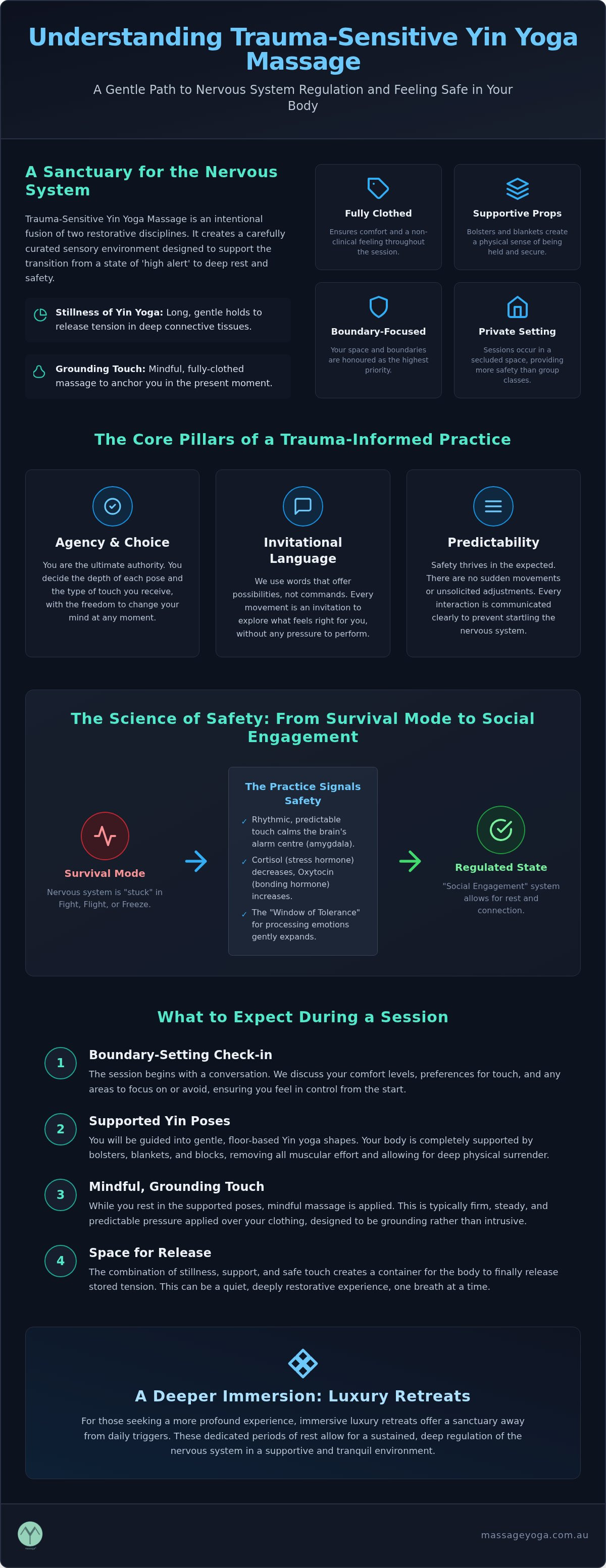
At its heart, trauma sensitive yin yoga massage is a deeply intentional fusion of two restorative disciplines. It isn't just a physical practice; it's a carefully curated sensory environment designed to support the transition from a state of "high alert" to the quietude of the parasympathetic nervous system. Unlike traditional massage settings that might feel exposed or clinical, this practice is performed entirely while you are fully clothed. We use supportive props; bolsters, blankets, and blocks; to create a physical sense of security, allowing your body to feel held before the first touch even occurs. It's about honouring your space and your boundaries.

The Core Pillars of Trauma-Informed Practice

The foundation of this work rests on the global principles of trauma-informed care, adapted specifically for the bodywork setting. In a private One on One Massoga® Treatment, three primary pillars guide every interaction:

  • Agency and Choice: You remain the ultimate authority over your body. You decide the depth of each pose and the type of touch you receive. You can change your mind at any moment.

  • Invitational Language: We use words that offer possibilities rather than commands. Every movement is an invitation to explore what feels right for you in that moment, without any pressure to perform.

  • Predictability: Safety thrives in the expected. There are no sudden movements or unsolicited adjustments. Every interaction is communicated clearly to ensure your nervous system isn't startled.

Why Yin Yoga is the Ideal Foundation

Yin yoga provides the perfect "laboratory" for this restorative work. Because the practice involves long, slow holds, it targets the fascia and connective tissues rather than the muscles. This slow pace is vital. It allows the body to soften without triggering the "fight or flight" response that can sometimes accompany faster, more vigorous movements. There is no Vinyasa flow here; only stillness and presence.

Safety isn't just a feeling; it's a physiological state. When you've experienced trauma, your nervous system often gets stuck in survival mode, oscillating between the frantic energy of flight or the heavy, numb sensation of freeze. Polyvagal Theory explains that for true rest to occur, we must move into the "social engagement" system. This is the ventral vagal state, where the heart rate slows and the body feels secure enough to connect. In a trauma sensitive yin yoga massage session, every element is designed to cue this vital shift.

Rhythmic, mindful touch acts as a direct communication line to the amygdala, the brain's alarm centre. When touch is predictable and consensual, it signals that the threat has passed. Research into how it calms the nervous system shows that these integrated practices decrease the production of stress hormones like cortisol. By grounding the body through proprioception, the sense of where your limbs are in space, you begin to inhabit your physical self again. Using bolsters and firm, steady pressure helps survivors feel their own edges, which is often lost during periods of dissociation. The window of tolerance is the optimal zone of arousal where we can process emotions and experiences without becoming overwhelmed or shutting down; this practice gently expands that space.

Oxytocin and the Power of Nurturing Touch

Safe, consensual touch triggers the release of oxytocin, a hormone that naturally counters the effects of adrenaline. For those who have experienced "touch trauma" or a long period of "touch hunger," physical contact can feel complicated. This practice offers a way to build a new, positive association with sensation. It's a gradual, respectful exposure that prioritises your comfort, allowing you to experience the nurturing benefits of human connection without the pressure of a clinical environment. If you feel ready to explore this quiet path, you might find solace in a tailored restorative experience.

Fascia, Trauma, and Emotional Release

Connective tissue, or fascia, is where the body often "keeps the score" of past stress. When we are under constant pressure, this tissue can become tight and restrictive. The slow, melting quality of Yin yoga is far more effective for trauma recovery than aggressive, fast-paced stretching, which can inadvertently trigger a defensive response. By holding shapes for several minutes and integrating soft tissue massage, we encourage the fascia to hydrate and soften. This process supports the gentle release of stored energy, allowing emotions to surface and pass through the body without the need to "push" or force a result. It is a profound way to reclaim your body's innate capacity for stillness. To explore how other restorative practices at a dedicated wellness sanctuary can support this journey, read more.

Restorative vs. Clinical: Why Choose a Private Massoga® Treatment?

Clinical therapy often focuses on diagnosis and "fixing" a condition, which can sometimes feel sterile or heavy for those already burdened by their experiences. In contrast, a restorative approach prioritises honouring your whole being. A private trauma sensitive yin yoga massage session isn't a medical treatment; it's a soulful sanctuary. We create a sensory cocoon using binaural beats and high-grade essential oils to anchor you gently in the present moment. Unlike traditional massage, which requires disrobing and can feel exposing, Massoga® is practised fully clothed. This simple, respectful shift removes a significant barrier to relaxation, allowing you to surrender into the support of the bolsters without any sense of vulnerability.

The Limitation of Group Yoga Classes

Standard yoga studios can be unexpectedly overwhelming. Mirrors, loud playlists, and crowded floors often trigger hyper-vigilance rather than peace. In these environments, "hands-on adjustments" are frequently unsolicited, which can be deeply distressing for someone navigating trauma. Choosing a One on One Massoga® Treatment ensures a 1:1 ratio where the focus remains entirely on your personalised nervous system regulation. You aren't just another student in a class; you are in a controlled, predictable space where every touch is discussed beforehand. This level of seclusion and safety is something group classes simply cannot match.

From Clinical Therapy to Embodied Wellness

Talk therapy is an essential tool for many, but trauma frequently resides in the tissues where words cannot reach. Somatic, or body-based, experiences act as a vital bridge, moving you from the "patient" identity into a space of embodied wellness. It's a transition from merely surviving to experiencing deep, restorative luxury. When considering what to expect in a session, it's helpful to view it as an invitation to rest rather than a clinical appointment. For those seeking a more profound immersion, our Private Retreat Yoga and Massage Australia: The 2026 Guide to Deep Rest offers the necessary distance from daily triggers to facilitate a true reset. By integrating trauma sensitive yin yoga massage with nurturing surroundings, we honour the body's innate need for both safety and profound care.

Trauma sensitive yin yoga massage

What to Expect in a Trauma Sensitive Massoga® Session

Your experience begins with a gentle, unhurried conversation. This pre-session check-in is a dedicated time to discuss your boundaries, identify any potential triggers, and highlight areas where you feel most comfortable receiving touch. It's a collaborative process. In a trauma sensitive yin yoga massage, you are never expected to "just relax" without first knowing exactly what will happen. We establish a roadmap together, ensuring you feel seen and respected before the stillness begins.

The Importance of the Sensory Environment

We curate every detail to create a physical cocoon that signals safety to your nervous system. Binaural beats play softly in the background, using specific sound frequencies to encourage your brain to enter a theta state, which is the restorative bridge between wakefulness and sleep. Grounding essential oils are selected to anchor your senses, while the lighting and temperature are adjusted to ensure you feel physically secure. This isn't just about comfort; it's about providing your body with constant, subtle cues that the environment is protected and predictable.

Empowerment Through Communication

Communication doesn't always have to be verbal, especially when you are in a deep state of introspection. We establish clear non-verbal signals, such as a simple hand gesture, so you can communicate your needs without having to speak aloud or break your internal focus. The "Stop" rule is absolute; you can end or pause the touch at any moment for any reason, without needing to provide an explanation. The practitioner focuses on holding a compassionate space for your internal process rather than simply performing a service upon you.

Once you have settled into a posture using supportive bolsters and props, the practitioner applies massage with steady, predictable movements. During these long, quiet holds, the practitioner integrates trauma sensitive yin yoga massage by applying rhythmic pressure to areas of tension. This approach allows the fascia to soften gradually, supporting the "un-layering" of physical and emotional stress. You aren't being moved or manipulated; you are being supported as your body finds its own way back to a state of ease.

Sustaining the afterglow requires a slow, intentional re-entry into the world. The transition back to your daily rhythm is treated with the same respect as the practice itself. You'll be given space to linger in the quietude of a deep nervous system reset, allowing the benefits of the session to integrate fully before you step outside. It's a process of returning to yourself, feeling more grounded and safe in your own skin than when you arrived.

Taking the Next Step: Private Sessions and Luxury Retreats

Transitioning from a life of constant vigilance to a state of profound rest is a journey of deepening trust with your own body. While we have explored the science and the structure of trauma sensitive yin yoga massage, the true transformation occurs when you allow yourself to fully inhabit the experience. Moving from a mindset of "doing"; fixing, managing, and coping; to a state of simply "being" is the ultimate goal of this restorative work. For many, this transition is best supported through private One on One Massoga® Treatments. These sessions build the foundational safety and predictability needed to eventually embrace the deeper, sustained immersion of a luxury retreat.

Immersive Healing on Magnetic Island

Nature acts as a powerful co-healer in the process of trauma recovery. Our sanctuary on Magnetic Island is not a standard holiday; it is a carefully held environment where the Australian landscape supports your journey inward. The rhythmic sound of the tides and the expansive stillness of the North Queensland bush provide a natural backdrop for the Massoga® Yoga Retreat Magnetic Island. By physically removing yourself from daily triggers; the emails, the noise, and the constant demands of others; you give your nervous system the space it needs to finally exhale. This immersion allows for a sustained period of regulation that is difficult to achieve in the busyness of home life. It is a time to soften, to breathe, and to remember what it feels like to be truly at ease.

Begin Your Journey of Restoration

If the idea of a full retreat feels like a distant shore, starting with a private Trauma Sensitive Massoga® session is a gentle way to begin. Led by founder Wallis Murphy-Munn, these sessions are tailored specifically to your unique needs and comfort levels. Preparing your mindset for this first experience involves letting go of the need to achieve a certain physical "result." Instead, approach it as a soulful invitation to rest. It is a process of softening the edges and allowing the trauma sensitive yin yoga massage to meet you exactly where you are today. You don't need to be "better" or "healed" to begin; you only need to be present.

Reclaiming Your Right to Stillness

Finding peace after trauma isn't about "fixing" what's broken; it's about creating a safe harbour where your body can finally stop fighting. We've explored how trauma sensitive yin yoga massage uses predictable touch and slow stillness to regulate the nervous system and expand your window of tolerance. This practice is more than just a treatment. It's a gentle reclamation of your own physical space and internal quietude, allowing you to move from a state of high alert into a profound, restorative surrender.

These founder-led private sessions with Wallis Murphy-Munn are backed by over 10 years of specialised bodywork experience. You might begin with a one-on-one treatment or choose the deep immersion of our luxury retreats, which are specifically designed for seclusion and silence. Every element is curated to ensure you feel held and respected. You deserve to feel safe in your own skin, and the path to restoration is open, waiting for you to take that first gentle, restorative breath.

Softness is your strength. We invite you to step into this sanctuary and rediscover the stillness that has always been yours.

Frequently Asked Questions

Is trauma sensitive yin yoga massage different from regular massage?

Yes, it is fundamentally different. While regular massage often focuses on muscle manipulation in a clinical setting, trauma sensitive yin yoga massage integrates the stillness of Yin yoga with mindful touch. It's a collaborative practice where you remain in control. We prioritise the nervous system's response over physical "fixing," using bolsters and binaural beats to create a safe sanctuary that traditional massage environments often lack.

Do I have to take my clothes off for a trauma-sensitive session?

No, you remain fully clothed throughout the entire session. This is a core pillar of our practice designed to lower the barrier for anyone who feels exposed or vulnerable in traditional massage settings. We recommend wearing comfortable, soft clothing that allows for easy movement in Yin yoga shapes. This ensures you can focus entirely on your internal experience and sensory regulation without any concerns about physical modesty.

What if I find certain yoga poses or touch triggering during the session?

Your safety and comfort are the absolute priority. If a pose or touch feels overwhelming, you are encouraged to use the pre-established "stop" signal or simply move out of the shape. We use invitational language; every suggestion is a choice, not a command. The practitioner holds space for your process and will immediately pause or adjust the session to ensure you remain within your personal window of tolerance.

How many sessions do I need to feel a change in my nervous system?

Many people report an immediate sense of relief after their first session, though lasting regulation is a cumulative process. You might notice a subtle shift in your baseline stress levels after three to five sessions as your body begins to trust the environment. Consistency with trauma sensitive yin yoga massage allows the fascia to soften and the brain to build new, positive associations with stillness, leading to deeper emotional release.

Is this practice suitable for people with complex PTSD?

Yes, this practice is specifically designed to support individuals navigating complex PTSD and other forms of trauma. By focusing on agency, choice, and predictability, we provide a container where the nervous system can begin to down-regulate. It complements clinical talk therapy by addressing the somatic, body-based symptoms of trauma that words alone often cannot reach. Our private treatments offer the seclusion necessary for those managing hyper-vigilance, and for clinicians and therapists looking to grow their professional work, you can learn more about Martin Hogg Private Practice Success.

Can I do trauma-sensitive yoga if I am not flexible?

Flexibility is not a requirement for this practice. In fact, Yin yoga is more about the internal sensation than the external shape. We use an abundance of props, including bolsters, blankets, and blocks, to bring the floor to you. This ensures your body is fully supported regardless of your range of motion. The goal is to find a gentle edge where you can remain still and breathe, not to achieve a pose.

What is the difference between this and traditional Vinyasa flow?

Massoga® is the opposite of a fast-paced Vinyasa flow. While Vinyasa focuses on rhythmic movement and strength, our practice is centred on stillness and surrender. There are no standing sequences, flows, or heat-building exercises. Instead, we hold floor-based poses for several minutes at a time. This slow pace is essential for trauma recovery, as it prevents the "fight or flight" response often triggered by vigorous, demanding physical activity.

How do I know if a practitioner is truly trauma-informed?

A truly trauma-informed practitioner prioritises your agency and clear communication. They will conduct a thorough check-in before any touch occurs and use invitational rather than commanding language. You should feel a sense of predictability and control throughout the session. At Massoga®, our foundation is built on these principles, with Wallis Murphy-Munn bringing years of specialised experience to ensure every private session or luxury retreat place feels profoundly safe.


Comments


Written by Wallis Murphy-Munn

Wallis Murphy-Munn is the founder of Massoga®, a unique practice that combines the therapeutic benefits of massage with the restorative elements of Yin Yoga.


Her hands-on teaching approach has led to deeper relaxation for her students, inspiring the creation of Massoga®.


In addition to her practice, Wallis enjoys writing blog articles to share her insights, advocating for the importance of human touch and simple connections in an increasingly isolated world.

14.png

About

Yoga Retreats

Other Services 

  • Instagram
  • Facebook
  • LinkedIn

We acknowledge the traditional owners of the land in all the regions of the beautiful countries we travel to and experience on retreat. The custodians of Kulin Nation, in the regions of the Woiworung, Boonwurrung and Wathaurong People. The custodians of the Yunbenun of the Wulgurukaba People. We acknowledge their Ancestors past, present and future who nurtured and cared for Country for tens of thousands of years.

© 2025 Massoga® Massage Yoga | Website by Insight Culture

bottom of page