top of page

Bodywork for Trauma Recovery: Somatic Healing in 2026

Writer: Massoga® Massage Yoga
Massoga® Massage Yoga
11 minutes ago
9 min read

What if the persistent tightness in your shoulders isn't just fatigue, but your nervous system quietly bracing for an impact that passed long ago? When you live locked in fight, flight, or functional freeze, you cannot simply rationalise your way back to ease. The body remembers what the mind tries to move past. This is why gentle bodywork for trauma recovery has become such a vital sanctuary, offering a bottom-up bridge to calm where words often fall short. If you have ever avoided traditional massage out of fear that deep, invasive pressure might trigger an internal alarm, your protective instincts were entirely right.


Somatic healing never asks you to endure discomfort; it invites your physical self to soften through continuous safety, slow touch, and conscious consent. In this guide, discover how gentle, trauma-informed bodywork releases stored tension and restores calm to an overwhelmed nervous system. We will explore how somatic touch down-regulates chronic fight-or-flight reflexes, how to choose a safe practitioner who honours your autonomy, and how restorative stillness can gently return you to yourself.


Table of Contents


What Is Trauma Bodywork and Why Is the Body Essential?


Pause for a moment. Feel the contact of your feet against the floor, or the quiet weight of your back against the chair. When traumatic stress enters our lives, it rarely confines itself to memory. It settles into our tissues, tightening fascia, shortening breath, and locking muscles into defensive postures. Trauma-informed bodywork is not simply a luxurious massage with softer music. It is a distinct, intentional modality that prioritises autonomic nervous system regulation through respectful, conscious contact.


Rather than attempting to manipulate soft tissue into forced submission, intentional bodywork for trauma recovery meets your physical bracing patterns with patience. Chronic tension is not a physical defect or an obstinate knot; it is survival energy that never had the opportunity to discharge. By offering steady, reassuring touch within a container of absolute bodily safety, this tactile work helps your somatic system release long-held vigilance without rekindling past overwhelm.


The Limitations of Cognitive Processing for Somatic Trauma


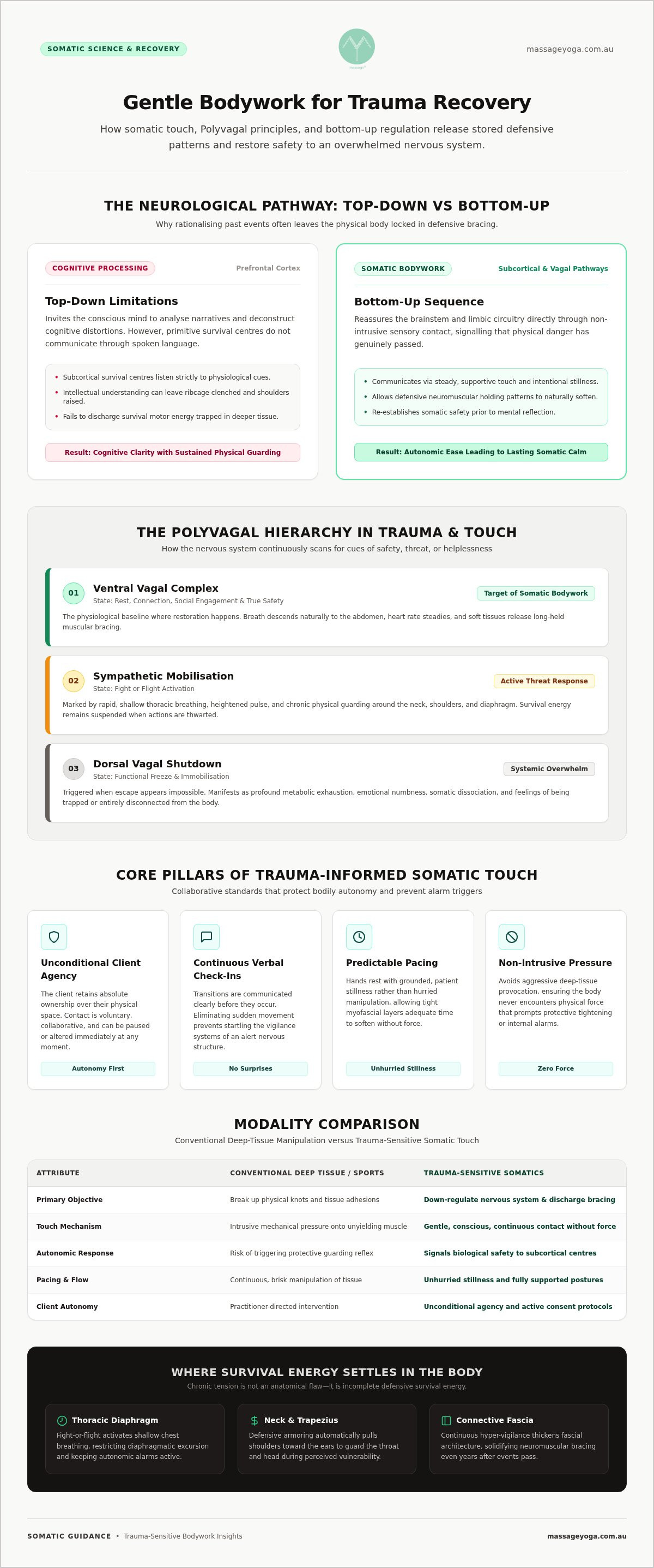
Traditional psychological therapies operate from the top down. They invite the prefrontal cortex to analyse narratives, deconstruct cognitive distortions, and make meaning of past distress. Yet the primitive survival centres of your brain, the brainstem and the limbic circuitry, do not speak fluent English. They listen exclusively to physiological cues of safety.


You can understand the root cause of your anxiety with total clarity while your ribcage remains clenched and your shoulders rest near your ears. Pioneering modalities such as Somatic Experiencing (SE) have long demonstrated that autonomic restoration requires a bottom-up sequence. Physiological signals must first reassure the subcortical brain that the threat has genuinely dissolved before the thinking mind can find lasting peace.


Core Pillars of Trauma-Sensitive Tactile Therapy


True somatic touch differs fundamentally from conventional clinical or sports massage, which frequently imposes pressure onto unyielding muscles. Restorative bodywork adopts a collaborative stance built on distinct boundaries:


  • Unconditional Client Agency: You retain complete ownership of the space. Touch is voluntary, collaborative, and immediately adjusted or paused at your request.

  • Continuous Verbal Check-Ins: Practitioners communicate transitions before they occur, eliminating sudden movements that could startle an alert nervous system.

  • Predictable Pacing: Hands rest with gentle, grounding stillness rather than hurried manipulation, giving tight fascia the time it requires to soften naturally.

  • Non-Intrusive Pressure: The work avoids deep-tissue provocation, ensuring your body never feels the urge to brace against the practitioner's hands.


Through this spacious, trauma-sensitive approach, bodywork for trauma recovery ceases to be an invasive intervention. It transforms into an invitation to let go, allowing your system to reclaim its natural rhythm of ease.


The Somatic Science: How Trauma Traps Stress in the Nervous System


Breathe out. Soften your jaw. Trauma is fundamentally a biological state of suspended survival activation. When an experience overwhelms your coping capacity, your nervous system mobilises enormous energy to fight or flee. If that instinct is thwarted, the incomplete motor response does not evaporate. It remains stored in your neuromuscular pathways as perpetual physical guarding.


The Polyvagal Hierarchy: Fight, Flight, and Freeze


Polyvagal Theory helps us understand how our nervous system continuously scans our environment for cues of safety or danger. When threat is perceived, the sympathetic branch initiates hyperarousal. This manifests physically as shallow chest breathing, elevated heart rates, and chronic bracing around the neck, shoulders, and diaphragm.


If danger feels inescapable, the system shifts into dorsal vagal shutdown. This survival state brings profound exhaustion, emotional numbness, bodily dissociation, and functional freeze. True restoration happens only within the ventral vagal complex, the physiological seat of rest, connection, and safety. Thoughtful bodywork for trauma recovery provides soothing, steady sensory signals that assist an overwhelmed system in gently stepping down from shutdown or hyper-vigilance into baseline ventral calm.


Fascia, Armoring, and Cellular Memory


Your connective tissue listens directly to your autonomic state. When emotional stress remains unresolved, the pliable web of fascia thickens and tightens to shield vital organs. Somatic pioneer Wilhelm Reich identified this pattern as muscular armoring, a structural defence mechanism where the body physically armours itself against recurring distress.


Forceful pressure often triggers this protective sheath to tighten further. Conversely, slow, prop-supported touch and sustained tactile reassurance warm the collagen matrix naturally. This unhurried physical presence allows incomplete survival impulses, such as subtle trembling or spontaneous deep exhales, to safely resolve at the tissue level. When your nervous system is ready to trade continuous defence for restorative stillness, you can join our community for gentle rest to support your ongoing healing journey.


Comparing Modalities: Massage, Somatics, and Restorative Movement


Not all hands-on practices offer the soothing sanctuary your body seeks. Selecting the right bodywork for trauma recovery requires understanding how different therapeutic modalities interact with a hyper-vigilant nervous system.


Why Standard Remedial Massage Can Overwhelm Traumatised Systems


Standard remedial or deep-tissue therapies often pursue an aggressive objective: stripping knots and forcing myofascial release. When muscular armoring is shielding unprocessed survival energy, intense physical pressure can feel like an intrusion. The sympathetic nervous system responds instantly with protective bracing, leaving you more exhausted or emotionally activated than when you arrived. Somatic healing replaces forceful tissue manipulation with patient listening, honouring your protective boundaries instead of overriding them.


The Synergy of Restorative Yin Yoga and Conscious Touch


Rest your entire weight into a bolster. When your limbs are fully cradled by props, your postural muscles no longer need to work to keep you safe. This passive physical support signals profound stability to the brainstem. Pairing supported stillness with slow, intentional touch deepens this physiological shift, encouraging parasympathetic down-regulation without demanding conscious effort.


This gentle synthesis builds on the foundations of trauma sensitive yoga Australia, where individual autonomy and supported stillness unite. Through unhurried, intentional bodywork for trauma recovery, your system receives clear physiological permission to release vigilance and settle into lasting ease.


Bodywork for trauma recovery


What to Expect in a Trauma-Sensitive Bodywork Session


Stepping into a healing space should feel like an immediate sensory exhale. The room is quiet, the lighting is soft and indirect, and the ambient temperature is calibrated to keep your muscles from shivering or guarding. There is no expectation to perform, explain, or push through discomfort. In a session of bodywork for trauma recovery, your physical and emotional autonomy guides every single moment.


Establishing Consent, Touch Boundaries, and Client Agency


Safety is built through absolute transparency before any hands-on contact occurs:


  • Step 1: Collaborative intake. We begin with a slow, grounded conversation exploring your comfort levels. You outline precisely where touch is supportive and designate off-limit areas without needing to justify your boundaries.

  • Step 2: Non-verbal stop signals. You establish clear, subtle signals, such as lifting a finger or raising a hand, that instantly pause the session. You hold full veto power over every touch.


Most trauma-sensitive somatic sessions take place fully clothed while you rest across ergonomic bolsters, heavy blankets, and soft props. Remaining comfortably dressed eliminates the vulnerability often felt on an uncovered treatment table, allowing your system to maintain its protective boundary while receiving care.


Navigating Somatic Releases During Hands-On Sessions


As defensive holding patterns soften, your body begins to process stored survival energy in small, manageable measures. Somatic practitioners refer to this gentle pacing as titration:


  • Step 3: Recognizing somatic releases. It is entirely normal to experience subtle fluttering, neurogenic tremors, sudden changes in body temperature, or involuntary sighs. These are not signs of distress; they are your nervous system safely completing interrupted stress responses.

  • Step 4: Real-time grounding. If emotional sensations arise, the practitioner pauses and guides your attention back to external anchors, like the solid floor beneath you or the soothing weight of a blanket, preventing sensory flooding.


Following your session, quiet integration is essential. Sipping warm water, taking a slow walk, and giving yourself spaciousness before re-entering demanding environments will help seal the calming effects of bodywork for trauma recovery into your daily physiology.


Restorative Stillness in Practice: The Trauma Sensitive Massoga® Approach


Stillness is not passive; it is an active state of cellular repair. Founded in 2016 by Wallis Murphy-Munn, Massoga® was created to unite the deep surrender of supported Yin yoga with the restorative warmth of hands-on massage. In our dedicated Trauma Sensitive Massoga® sessions, we step away from demanding physical routines entirely. There are no intense postures, no complex sequences, and no performance expectations. Instead, your body is completely cradled in prop-supported shapes while slow, intentional touch guides your nervous system back toward safe equilibrium.


Bespoke Care Through One-on-One and At-Home Sessions


Group settings can occasionally trigger subtle social vigilance, especially when your system is navigating functional freeze or hyperarousal. Our One on One Massoga® Treatments remove that pressure completely. Within dedicated individual care, the pacing slows to match your exact rhythm. Every bolster adjustment and tactile touch responds directly to your comfort and cues.


For those who find travelling to unfamiliar clinics disorienting, Massoga® at Home brings this nurturing work into your personal sanctuary. Eliminating sensory overstimulation and traffic protects your autonomic safety, making gentle bodywork for trauma recovery accessible in the comfort of your own living room. When you are ready to experience unhurried somatic care, you can book a private session tailored around your present needs.


Immersive Healing Environments and Next Steps for Rest


Deep, sustained somatic repair often asks for extended breathing room away from the relentless momentum of daily obligations. Stepping into nature amplifies nervous system down-regulation, providing rich sensory signals of quietude and ease. Our dedicated restorative wellness retreats offer an immersive sanctuary where time slows down. Surrounded by supportive community and peaceful natural landscapes, you are held in an environment designed entirely for deep rest.


Healing from chronic survival stress does not require pushing harder. It begins when you finally give yourself permission to soften and drop the weight. By embracing gentleness, continuous agency, and supported stillness, bodywork for trauma recovery opens an enduring doorway back to your own calm centre.


Reclaiming Felt Safety Through Restorative Touch


Real autonomic recovery begins when your nervous system feels safe enough to stop guarding. Rather than forcing tight muscles into submission, gentle bodywork for trauma recovery offers a profound physiological permission slip to soften. Since 2016, Wallis Murphy-Munn has pioneered this integrative path through Massoga®, thoughtfully pairing prop-supported Yin yoga with unhurried therapeutic touch. Every offering centres entirely on client-led agency, continuous consent, and deep nervous system regulation.


Whether you choose bespoke one-on-one treatments, peaceful home appointments, or immersive restorative retreats crafted for profound recovery, true somatic reclamation unfolds in its own time. Be gentle with your pace. Your body already possesses an innate wisdom to unwind, rest, and return to ease when met with unwavering safety.


Frequently Asked Questions


How does bodywork help release trauma stored within the body?


Trauma bodywork helps release stress by communicating safety directly to the subcortical brain through slow, steady sensory touch. When muscles perpetually brace to protect survival energy, words cannot convince them to relax. Therapeutic bodywork for trauma recovery works from the bottom up, soothing sympathetic hyperarousal and warming tightened fascia. This reassuring physical contact signals your autonomic nervous system that the threat has passed, allowing incomplete survival impulses to safely discharge.


What is the main difference between standard massage and trauma-informed bodywork?


Standard massage focuses primarily on mechanical outcomes, such as kneading tight knots or breaking down adhesions with deep pressure. Conversely, trauma-informed bodywork prioritises nervous system regulation and felt safety. It eliminates painful tissue manipulation in favour of gentle, collaborative contact. Practitioners work at an unhurried pace, establish continuous consent, and honour your somatic boundaries so your protective bracing never feels challenged or overwhelmed.


Can bodywork trigger a traumatic memory or emotional release during a session?


As chronically braced muscles soften, spontaneous emotional releases like sudden tears, sighing, or temperature shifts can occasionally occur. A skilled practitioner titrates the session to prevent emotional flooding. If an unexpected memory surfaces, hands-on work pauses immediately. The practitioner guides your focus back toward external grounding anchors, such as steady breathing or the solid support beneath your body, ensuring you remain anchored in present-moment safety.


Do I have to take my clothes off during a trauma-sensitive bodywork session?


No, you remain fully clothed throughout the session. In trauma-sensitive practices like Trauma Sensitive Massoga®, you rest comfortably in soft attire while supported by generous bolsters and weighted blankets. Removing clothing can introduce unnecessary vulnerability for an alert nervous system. Staying dressed maintains your personal physical boundary, letting your system feel completely secure while receiving slow, therapeutic touch.


How many trauma-informed bodywork sessions are typically needed to feel relief?


Many individuals feel an immediate sense of physiological decompression after their initial session. However, unwinding years of muscular armouring is an ongoing somatic journey rather than a quick fix. Engaging in bodywork for trauma recovery across several spaced treatments allows your system to build lasting neural pathways of ease. Your practitioner collaborates with you to determine a sustainable rhythm that respects your personal healing capacity.


Is bodywork safe for someone currently experiencing acute PTSD or anxiety?


Yes, provided the practitioner is specifically trained in trauma sensitivity and nervous system down-regulation. Because sessions emphasise complete client agency and continuous consent, you retain full control over pacing and touch boundaries. That said, somatic bodywork serves as a powerful complementary modality rather than a standalone medical cure. If you are navigating acute PTSD, pairing restorative touch with an accredited mental health professional provides optimal support.


Comments


Written by Wallis Murphy-Munn

Wallis Murphy-Munn is the founder of Massoga®, a unique practice that combines the therapeutic benefits of massage with the restorative elements of Yin Yoga.


Her hands-on teaching approach has led to deeper relaxation for her students, inspiring the creation of Massoga®.


In addition to her practice, Wallis enjoys writing blog articles to share her insights, advocating for the importance of human touch and simple connections in an increasingly isolated world.

14.png

About

Yoga Retreats

Other Services 

  • Instagram
  • Facebook
  • LinkedIn

We acknowledge the traditional owners of the land in all the regions of the beautiful countries we travel to and experience on retreat. The custodians of Kulin Nation, in the regions of the Woiworung, Boonwurrung and Wathaurong People. The custodians of the Yunbenun of the Wulgurukaba People. We acknowledge their Ancestors past, present and future who nurtured and cared for Country for tens of thousands of years.

© 2025 Massoga® Massage Yoga | Website by Insight Culture

bottom of page