top of page

Yin Yoga for Nervous System Regulation: The 2026 Guide to Deep Recovery

  • Writer: Massoga® Massage Yoga
    Massoga® Massage Yoga
  • 11 hours ago
  • 13 min read

What if the reason you feel permanently "on" isn't a lack of discipline, but a nervous system that has forgotten the language of safety? You know the feeling well. It is the brittle edge of overwhelm that surfaces during a busy afternoon; it is the frustrating hum of a mind that refuses to settle even when your body is spent. By embracing yin yoga for nervous system regulation, you can begin to signal to your body that the threat has passed. It is a gentle, soulful invitation to stop performing and start being.

In this guide, you'll discover how the deliberate stillness of Yin Yoga resets a frazzled physiology and why deep rest has emerged as the most essential wellness trend of 2026. We'll explore the science of vagal tone, the importance of creating internal space, and how the Massoga® method facilitates emotional resilience through restorative immersion. You will learn why softening is more powerful than pushing, and how to reclaim a sense of calm that lasts long after you leave the mat. It is time to exhale, let go, and settle into the quiet recovery your body deserves.

Table of Contents

Beyond the Burnout: Why Your Nervous System is Permanently 'On'

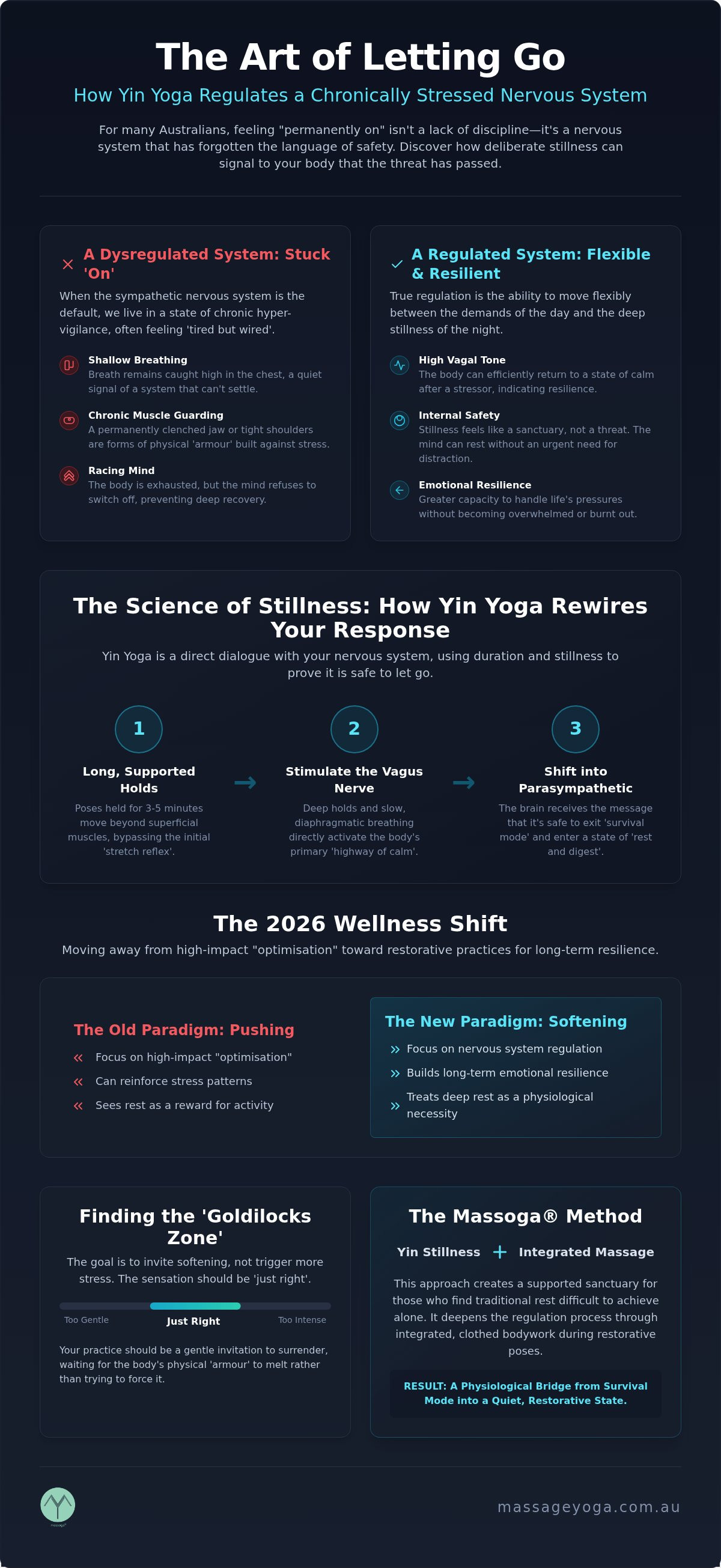
True nervous system regulation isn't about the absence of stress. It is the ability to move flexibly between the demands of your day and the deep stillness of your night. For many high-achieving Australians, this flexibility has withered. We find ourselves trapped in a "tired but wired" loop, where the body is heavy with exhaustion but the mind continues to race like a motor that won't switch off. By integrating yin yoga for nervous system regulation into your routine, you can begin to restore this lost flexibility. You might notice your breath remains shallow in your chest, or perhaps you've realised your jaw is permanently clenched; these are the quiet signals of a system that no longer feels safe to settle.

This state is particularly common for "The Woman Everyone Depends On." She is the emotional anchor for her family, the reliable lead at work, and the person everyone calls in a crisis. Because she is always holding space for others, her own system stays on high alert, scanning for the next requirement or emergency. This chronic muscle guarding and mental load create a barrier to true rest. For her, deep recovery isn't a luxury; it's a physiological necessity to prevent total burnout and reclaim her internal space.

The Cost of Constant Hyper-Vigilance

When the sympathetic nervous system becomes our default setting, we live in a state of chronic hyper-vigilance. Our bodies are flooded with cortisol, which was designed for short bursts of survival, not for months of navigating a busy career or complex family life. This chemical saturation erodes our emotional resilience and makes traditional rest feel incredibly uncomfortable. If you've ever tried to sit still only to feel a surge of anxiety or an urgent need to check your phone, you've experienced this dysregulation. Your brain has mistaken stillness for vulnerability, making it difficult to access the restoration you desperately need.

Softening the Armour: The Role of Yin Yoga

Using yin yoga for nervous system regulation allows us to begin the process of "un-patterning" these stress responses. Throughout our lives, we build physical armour, literal tension in our fascia and connective tissues, to protect ourselves from emotional or physical pressure. Yin Yoga doesn't ask you to push through this armour; it invites you to wait for it to melt. By holding supported shapes for several minutes, we communicate directly with the nervous system, proving through experience that it is safe to let go. This practice is especially transformative in immersive environments, such as a Massoga® Yoga Retreat on Magnetic Island, where the external world is curated to support your internal softening. Yin Yoga acts as a physiological bridge, gently guiding the body from the high-frequency hum of survival mode into the quiet, restorative sanctuary of the parasympathetic state.

The Science of Stillness: How Yin Yoga Targets the Vagus Nerve

The vagus nerve is the body's primary highway of calm. It is the longest cranial nerve, acting as the essential command centre for your relaxation response. When we use yin yoga for nervous system regulation, we are engaging in a direct dialogue with this nerve. By settling into a posture for three to five minutes, we move beyond the superficial muscles and begin to signal to the brain that the environment is safe. This duration is critical; it allows the body to bypass the initial "stretch reflex" and enter a state of physiological surrender. It is here, in the quiet depths of a hold, that the brain finally receives the message that it no longer needs to scan for threats.

A key indicator of your resilience is vagal tone, a measurable reflection of how efficiently your nervous system can return to a state of calm after a stressor. High vagal tone is associated with better emotional regulation and improved heart health. Yin Yoga functions as a gentle form of training for this system, gradually teaching your body to toggle back into a restorative state with greater ease. If you feel your system is ready to begin this journey toward spaciousness, you might consider a one-on-one Massoga® treatment to experience this regulation in a supported, private setting.

The Parasympathetic Shift: Moving into Rest and Digest

Slow, rhythmic breathing is the lever that shifts the gears of your heart rate. In a Yin practice, we focus on long, smooth exhales that encourage the diaphragm to physically stimulate the vagus nerve. This deliberate lack of movement reduces the constant stream of sensory noise that keeps the modern mind on high alert. Stillness is not merely a lack of action; it is a skill that must be cultivated with intention. It requires a patient willingness to sit with the initial hum of restlessness until the body chooses to soften and descend into the "rest and digest" state.

Fascia and the Somatic Experience of Stress

Your nervous system is intricately woven into your fascia, the silvery webbing of connective tissue that wraps around every muscle and organ. Stress lives here. It manifests as tight hips, a heavy chest, or a stiff neck that won't release despite your best efforts. Long-held Yin shapes provide a gentle, sustained pressure that encourages myofascial release, sending calming feedback to the brain. This process creates a tangible sense of "internal space," allowing for a feeling of physical and mental expansion. By softening these tissues, we are quite literally un-patterning the somatic memory of stress and making room for deep, restorative healing.

The 2026 Wellness Shift: Why Regulation is the New Fitness

By 2026, the global conversation around health has undergone a profound transformation. We are witnessing a move away from the relentless pursuit of "optimisation" and toward a deeper, more soulful commitment to restoration. For years, fitness was measured by how much we could endure; now, it is measured by how well we can recover. This shift recognises that a high-performance life is unsustainable without a high-performance recovery system. Land. Soften. Breathe. At the heart of this movement is the understanding that yin yoga for nervous system regulation is not just a luxury. It is the essential foundation upon which all other health goals, from hormonal balance to mental clarity, are built. Without a regulated system, even the most perfect diet or supplement regime will struggle to take root in a body that feels constantly under siege.

Why 'Sweating it Out' Isn't Always the Answer

For those already navigating the brittle edges of burnout, high-intensity exercise can be a wolf in sheep's clothing. While a vigorous run or a fast-paced class might offer a temporary endorphin hit, it often adds another layer of stress to an already overloaded sympathetic system. This "exercise-induced stress" can leave you feeling even more depleted, further entrenching the "tired but wired" state. When your body is screaming for a "soft exhale," pushing it through another "high-intensity" session can exacerbate dysregulation and prolong the recovery process. This is why many are questioning the traditional path and exploring Yin Yoga vs. Vinyasa: Why We Choose Stillness. In a world that demands we always be "on," the most radical and effective act of fitness is choosing to be still.

The Rise of Integrated Bodywork

As Australians grapple with the weight of digital fatigue, "Slow Wellness" has emerged as a vital antidote to our hyper-connected lives. We see a rising demand for boutique, one-on-one experiences that prioritise human connection and tactile support over digital apps and automated routines. This has led to the growth of integrated bodywork, where the deliberate stillness of Yin Yoga is combined with the nurturing touch of massage. This synthesis provides a unique level of safety that a standard group class often cannot replicate. When a practitioner's hands provide a steadying presence during a long-held pose, the nervous system receives a powerful cue that it is safe to surrender. You don't have to navigate this journey alone; it's a shared experience of deep presence. This integrated approach ensures that the practice of yin yoga for nervous system regulation becomes a deeply personal journey of release and reconnection, allowing the body to finally drop its guard.

Yin yoga for nervous system regulation

Cultivating Internal Safety: A Practical Guide to Yin for Regulation

Creating a sense of safety within the body is a deliberate act of self-care. For those who carry the weight of others' needs, the transition into stillness can feel daunting. By following a structured 5-step framework, you can use yin yoga for nervous system regulation to gently guide your physiology back to a state of equilibrium. Start by grounding your physical space. Slowly enter a shape. Find your appropriate edge. Resolve to remain still. Finally, allow the element of time to do the work. This methodical approach ensures you aren't just "doing" yoga, but actively retraining your brain to recognise safety in the present moment.

Creating Your Sanctuary for Rest

Your environment acts as the first signal to your brain. To begin, dim the lights and ensure the room is a comfortable temperature; a cold body is a guarded body. Silence or soft, ambient sounds help to lower the heart rate. If you find yourself feeling "permanently on," these sensory cues are vital for breaking the cycle of hyper-vigilance. Learning how to teach your body to switch off is a practice of patience. It is about creating a sanctuary where you are no longer responsible for anyone else's well-being but your own.

The Three Tattvas (Principles) of Yin Yoga

The practice is governed by three essential principles, or Tattvas, that safeguard your nervous system. First, find your appropriate edge. This is the "Goldilocks Zone" of sensation; it should feel like a dull ache or a gentle tug, never a sharp or electric pain. If you push too far, your system will tighten in defence. Second, resolve to remain still. Once you've found your edge, commit to the shape. This stillness reduces sensory input, allowing the mind to settle. Third, hold for time. The magic of yin yoga for nervous system regulation happens in the three to five minute window, where the fascia begins to hydrate and the vagus nerve is stimulated.

Props are your best friends in this journey. Using bolsters, blocks, or even thick cushions provides the physical support necessary for the muscles to truly let go. When the body feels held, the nervous system can finally drop its guard. This is why trauma-sensitive cues are so important; they offer you choices and agency over your practice. You are the expert of your own experience. You decide how deep to go and when to pull back, which is the ultimate form of internal safety.

The Massoga® Method: Deepening Regulation Through Integrated Bodywork

Massoga® represents a profound evolution in the practice of yin yoga for nervous system regulation. It is a trademarked synthesis of restorative Yin stillness and the nurturing, tactile support of professional massage. While standard yoga practices often require you to manage your own alignment and mental focus, the Massoga® Method invites you to surrender that responsibility to a skilled practitioner. In a one-on-one setting, the sense of safety is amplified. You aren't distracted by the movement of others or the ambient noise of a large group; instead, you are held in a quiet, dedicated space where every adjustment is tailored to your body's specific needs. It's an invitation to stop doing and start being.

Professional bodywork acts as a catalyst for the parasympathetic shift. As you settle into a supported pose, the application of gentle, rhythmic touch helps to melt away the deep-seated physical tension that your mind might still be clinging to. This integrated approach ensures that the physical "armouring" we explored earlier is addressed both through internal release and external support. For those with demanding schedules, "Massoga® at Home" offers a practical entry point, bringing this specialised level of regulation into the sanctuary of your own living space.

The Power of Tactile Connection

Tactile connection is a powerful language that the nervous system understands instantly. When professional massage is applied during a Yin hold, it deepens the release within the connective tissues and fascia. This isn't just about physical comfort; it's about providing the neurological feedback required to let go of chronic muscle guarding. It's a soft, immersive experience that allows the heart rate to slow and the breath to deepen without effort. By combining these disciplines, we create a unique path to wellness that respects the complexity of the human condition and the necessity of human touch in the restorative process.

Your Journey to Deep Rest

The transition from understanding the science of rest to actually experiencing it is where true transformation happens. While learning about vagal tone is valuable, the sensory relief of a Massoga® session provides a tangible proof of safety that words cannot replicate. For a total nervous system reset, the luxury yoga retreat Magnetic Island stands as the ultimate sanctuary. Here, the external world is quietened, allowing you to immerse yourself fully in the restorative rhythms of the Massoga® Method. It's a soulful invitation to step out of the busyness of life and into a state of deep presence. Soften. Breathe. Surrender. The path to recovery is waiting for you.

Reclaiming Your Internal Space

The journey from a state of permanent hyper-vigilance to one of deep, internal safety is a process of un-patterning the stress our bodies have carried for years. We've explored how the deliberate practice of yin yoga for nervous system regulation acts as a bridge to the parasympathetic state, allowing the vagus nerve to signal true safety to the brain. As Australia’s original integrated massage and yoga practice, Massoga® has spent years refining a specialised, trauma-sensitive approach designed for high-achieving women who find traditional rest difficult to reach alone.

Whether you are seeking the science-backed benefits of fascia release or the immersive sanctuary of a luxury retreat, the path to recovery is built on the foundation of being held. There is a profound relief in finally letting go and allowing your system to reset in an environment designed for your deepest needs. You've spent long enough being the anchor for everyone else; it's time to find your own centre of calm.

Your body is ready for this soft exhale. Take the first step toward the deep, restorative rest you deserve and rediscover the spaciousness within.

Frequently Asked Questions

Is Yin Yoga the same as Restorative Yoga for the nervous system?

Yin Yoga and Restorative Yoga are distinct practices with different physiological targets. While Restorative Yoga aims for total support and zero sensation, Yin Yoga involves a mild, dull stress on the connective tissues. This "edge" is held for several minutes to encourage fascia release. Both practices support the nervous system, but Yin is specifically effective for un-patterning deep somatic tension and improving long-term physical resilience through gentle, sustained load.

How often should I practice Yin Yoga to see results in my stress levels?

You will often feel a tangible sense of relief after just one session of yin yoga for nervous system regulation. For those managing chronic stress, a weekly commitment helps to steadily build vagal tone. If you are navigating significant burnout, an immersive luxury retreat offers a more concentrated reset. This allows your body to remain in a parasympathetic state for several days, which is often more effective than sporadic home practice.

Can Yin Yoga help with chronic insomnia and sleep issues?

Sleep issues are frequently a sign that your body is stuck in a state of hyper-vigilance. Yin Yoga helps by down-regulating the sympathetic nervous system and encouraging the "rest and digest" response. By focusing on long exhales and physical stillness, you can lower your heart rate and prepare your brain for sleep. Many practitioners find that a regular evening practice significantly improves both the speed of falling asleep and the quality of rest.

What if I can't stay still or find the silence uncomfortable?

It is completely normal to find stillness challenging if your system is used to being permanently "on." Restlessness is simply a signal that your nervous system is scanning for activity. In our private treatments, we use tactile massage to provide a physical anchor for your mind. This hands-on support makes the silence feel less vulnerable. Over time, you'll find that your capacity for stillness grows as your body begins to trust the environment.

Do I need special equipment to start practicing Yin Yoga for regulation?

You don't need professional studio equipment to begin. While bolsters and blocks are helpful, you can easily organise substitutes from around your home. Firm cushions, rolled-up towels, or even a stack of sturdy books can provide the support your body needs to feel safe. The priority is ensuring that you aren't straining to hold a shape, as the nervous system can only regulate when the body feels fully supported.

Is Yin Yoga safe if I have a history of trauma or high anxiety?

Yin Yoga is a safe and powerful tool for trauma recovery when practised with appropriate guidance. Our specialised Trauma Sensitive Massoga® sessions prioritise your agency and choice at every step. We avoid high-pressure cues and instead offer a soulful invitation to explore sensation at your own pace. This approach ensures you remain in control of your experience, which is the most essential element of cultivating a sense of internal safety.

Can I practice Yin Yoga if I am not flexible?

You don't need to be flexible to start yin yoga for nervous system regulation. The practice isn't about achieving a specific aesthetic shape; it's about finding the point where you first feel resistance in your body. This "edge" is unique to everyone. Because we use props to support your alignment, the focus remains on your internal state of calm rather than how far you can stretch your hamstrings or hips.

How does massage during Yin Yoga actually work?

In the Massoga® method, massage is integrated into the Yin shapes to deepen the restorative experience. As you hold a pose, the practitioner applies gentle touch to areas like the shoulders, neck, or lower back. This tactile connection provides an external cue of safety that helps your muscles to soften more effectively. It’s a unique form of bodywork that addresses both the physical tension in the fascia and the neurological state of the mind.


Comments


Written by Wallis Murphy-Munn

Wallis Murphy-Munn is the founder of Massoga®, a unique practice that combines the therapeutic benefits of massage with the restorative elements of Yin Yoga.


Her hands-on teaching approach has led to deeper relaxation for her students, inspiring the creation of Massoga®.


In addition to her practice, Wallis enjoys writing blog articles to share her insights, advocating for the importance of human touch and simple connections in an increasingly isolated world.

14.png

About

Yoga Retreats

Other Services 

  • Instagram
  • Facebook
  • LinkedIn

We acknowledge the traditional owners of the land in all the regions of the beautiful countries we travel to and experience on retreat. The custodians of Kulin Nation, in the regions of the Woiworung, Boonwurrung and Wathaurong People. The custodians of the Yunbenun of the Wulgurukaba People. We acknowledge their Ancestors past, present and future who nurtured and cared for Country for tens of thousands of years.

© 2025 Massoga® Massage Yoga | Website by Insight Culture

bottom of page