top of page

The 2026 Guide to Choosing a Slow Wellness Retreat in Australia

  • Writer: Massoga® Massage Yoga
    Massoga® Massage Yoga
  • Aug 20
  • 11 min read

What if the holiday you took to find rest actually left you feeling more depleted? Close your eyes. Soften your shoulders. Exhale. Many people find that a typical wellness retreat in Australia feels like another "to-do" list, filled with early alarms and rigid schedules that mimic the very busyness they're trying to escape.

You likely recognise that feeling of being stuck in fight-or-flight mode, even when you're supposed to be relaxing. With the Australian wellness economy reaching USD 20.71 billion in 2025, it's easy to get lost in the noise of wellness tourism. You deserve a sanctuary that understands the difference between a busy itinerary and true restoration. This guide will help you identify a genuine slow wellness retreat Australia that prioritises nervous system regulation over performance. We'll explore how to choose experiences that focus on integrated bodywork and deep rest, moving away from the "maximum effort" trends of the past. You'll learn how to find a space where you can finally soften, let go, and return home feeling truly restored, not just away.

Table of Contents

What Defines a True Slow Wellness Retreat in Australia?

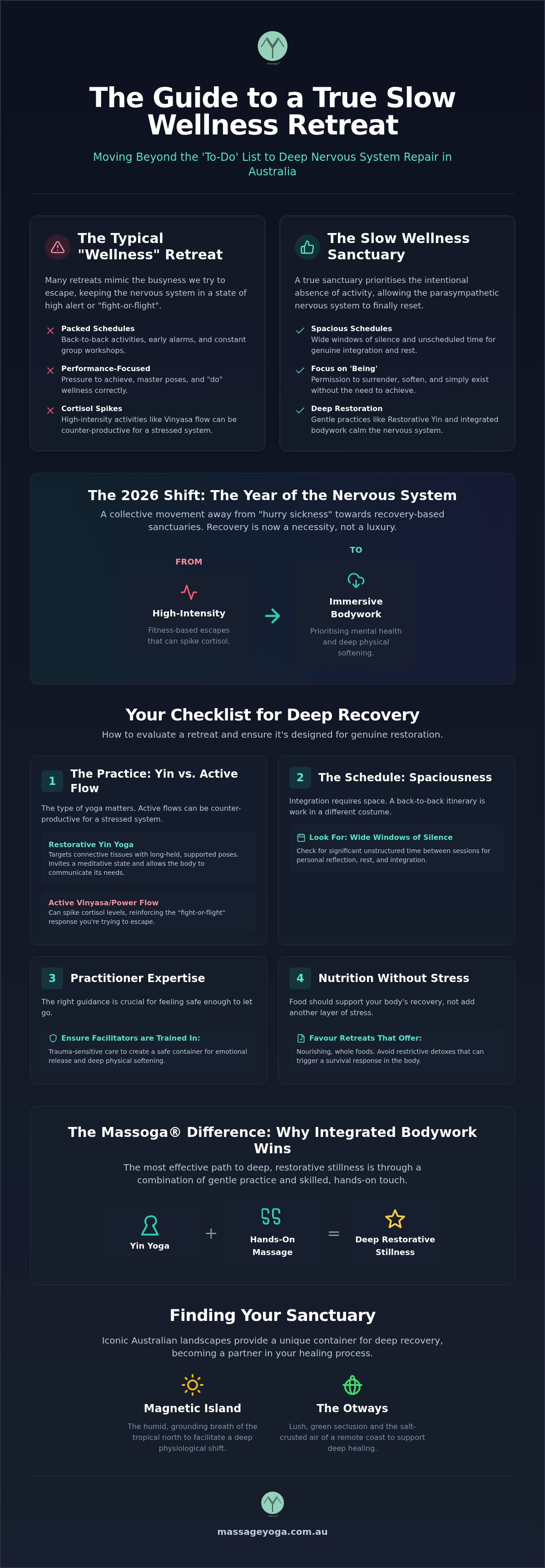
Soften your gaze. Listen to the rhythm of your own breath. A true slow wellness retreat Australia isn't a collection of activities; it's the intentional absence of them. Most programs offer a packed schedule of sunrise hikes, group workshops, and back-to-back classes. While well-intentioned, these itineraries often keep the body in a state of performance and "doing." A restorative sanctuary acts as a soft exhale for the soul, moving you away from the pressure to achieve even in your downtime. Slow wellness is a methodology for resetting the parasympathetic nervous system through intentional stillness and sensory integration.

Australia's vast, ancient landscapes provide a unique container for this deep recovery. Whether it's the humid, grounding breath of the tropical north or the salt-crusted air of a secluded coast, our natural environment facilitates a physiological shift that city life cannot replicate. Unlike wellness tourism, which often focuses on external results or clinical procedures, a slow retreat prioritises your internal state. It's about creating a space where the nervous system no longer feels the need to defend itself against the world. At places like our Massoga® Yoga Retreat Magnetic Island, the environment itself becomes a partner in your healing process.

The Philosophy of Deep Rest

True rest requires more than just a break from work; it demands a transition from "doing" to "being." Traditional retreats often fill every hour with self-improvement tasks that feel like another form of labour. In contrast, a slow approach removes the noise. By reducing external stimuli and embracing sensory immersion, the body finally feels safe enough to process stored tension. It's a deliberate unravelling. You aren't here to tick boxes or master a pose. You're here to surrender to the present moment and allow your physical form to soften into the support beneath you.

Why 2026 is the Year of the Nervous System

We've reached a tipping point with "hurry sickness." In 2026, the collective focus has shifted from fitness-based escapes to recovery-based sanctuary. Australians are increasingly prioritising mental health through immersive bodywork rather than high-intensity routines that further spike cortisol. This movement is a soulful counter-culture to the constant "on" state of modern life. We're learning that the most productive thing we can do for our long-term health is to stop. Recovery is no longer a luxury; it's a necessity for survival in a fragmented, high-speed world.

Evaluating Your Retreat: A Checklist for Deep Recovery

Take a slow breath. Feel the weight of your body against the chair. When searching for a slow wellness retreat Australia, it's easy to be seduced by beautiful imagery. However, true restoration lies in the methodology. You must look beyond the surface. Does this schedule allow your nervous system to actually settle? Or is it merely another form of wellness performance? True recovery requires a space that values your silence over your output.

Restorative Yin vs. Active Flow

Many traditional retreats favour Vinyasa or "power" flows. For a nervous system already stuck in fight-or-flight, these active movements can be counter-productive. They often spike cortisol levels when you most need to descend into rest. Yin yoga, by contrast, focuses on long-held, supported poses that target the connective tissues and fascia. This stillness invites a deeper meditative state than movement ever could. By integrating mindfulness exercises into these quiet moments, you allow the body to communicate its needs. You move from the stress of doing into the peace of being.

A restorative sanctuary should also be evaluated on these critical points:

  • Practitioner Expertise: Ensure facilitators are trained in trauma-sensitive care. This ensures a safe container for emotional release and deep physical softening.

  • The Schedule: Look for wide windows of silence. Integration requires space. A back-to-back itinerary is simply work in a different costume.

  • Nutrition without Stress: Favour retreats that offer nourishing, whole foods. Avoid restrictive detoxes that can trigger a survival response in the body.

The Importance of Seclusion and Environment

The location of your escape is more than just a backdrop. Whether you're choosing a luxury yoga retreat in Australia set within a lush forest or along a rugged coastline, the environment plays a pivotal role. Nature acts as a mirror for your internal state. True seclusion allows you to disconnect from urban noise and reconnect with the natural world. Look for a sanctuary that prioritises privacy and immersion over hotel-style amenities. If you feel the call to begin this journey of unravelling, you might consider how a dedicated space for rest could transform your well-being.

The Massoga® Difference: Why Integrated Bodywork Wins

Soften your breath. Let the weight of the day dissolve into the mat beneath you. When you seek a slow wellness retreat Australia, you're often presented with a menu of separate activities. You might have a yoga class in the morning and a massage booked for the afternoon. While both are beneficial, they exist as isolated events. Massoga® changes this narrative by weaving these disciplines together into a single, seamless experience of integrated bodywork. Founded in 2016 by Wallis Murphy-Munn, this unique method ensures you aren't just "doing" yoga; you're being held in a state of profound physical and mental surrender.

The magic lies in the synergy of touch and stillness. As you settle into a restorative Yin pose, a practitioner provides hands-on massage, guiding your body to release tension it has held for years. This isn't a standard adjustment; it's a dedicated therapeutic intervention designed to deepen your relaxation response. You can explore the benefits of massage and Yin yoga for the nervous system to understand how this combination facilitates a level of recovery that movement alone cannot reach.

Massage and Yoga Combined

Tactile feedback is a powerful tool for the brain. When a skilled practitioner applies pressure during a long-held pose, it sends a signal to your nervous system that it's safe to switch off. This immediate sensory cue helps you move past the "chatter" of the mind and descend into a meditative state. Integrated bodywork is particularly effective for releasing deep-seated physical trauma stored in the fascia. By receiving massage while the muscles are relaxed and the breath is steady, the body can process stress more efficiently than in a traditional, high-pressure massage session.

Trauma-Sensitive Care in a Luxury Setting

True luxury is the ability to surrender all decision-making. For high-stress individuals, even choosing a spa treatment can feel like another task. At our retreats, every element is thoughtfully curated to ensure you feel seen and safe without having to lift a finger. Wallis Murphy-Munn’s specialised trauma-sensitive approach creates a container of profound safety. This is especially vital for those whose nervous systems are stuck in a state of hyper-vigilance. You're invited to simply arrive and be cared for. In this space, there's no performance required. There's only the gentle invitation to soften, immerse yourself in the experience, and allow your body to lead the way toward healing.

Slow wellness retreat Australia

Finding Your Sanctuary: Iconic Australian Retreat Locations

Step into the landscape. Let your surroundings dictate the pace of your recovery. When choosing a slow wellness retreat Australia, the environment is as vital as the practice itself. Each ecosystem offers a different energetic frequency for healing. The Great Barrier Reef provides the expansive, fluid energy of the ocean; the rainforest offers the grounding, ancient wisdom of the earth; and the rugged coast brings the clarifying power of the wind. Matching your internal needs to the external environment is the first step toward a profound sense of physical and mental relief.

Magnetic Island: Tropical Stillness

Magnetic Island is a unique sanctuary of ancient granite boulders and turquoise waters. Its geology is unlike any other part of the Queensland coast, providing a sense of solid, unshakeable grounding. When you explore our Magnetic Island retreat, you'll find that the humid, warm air encourages the body to soften naturally. Island life moves at a different tempo. Here, the Massoga® method flourishes, as the rhythmic sound of the Coral Sea acts as a natural metronome for your breath. It's a place where you can truly savour the luxury of being still. In 2026, we're seeing a return to these tropical sanctuaries as people seek the healing power of oceanic warmth to thaw the tension of city living.

The Otways: Forest Immersion

If your soul craves deep introspection, the mist-shrouded forests of the Otways provide the perfect container. Victoria's ancient cool-temperate rainforests are ideal for the practice of "forest bathing," a sensory experience that involves fully immersing yourself in the forest atmosphere. The dense canopy reduces external noise, creating a quietude that supports a deep internal journey. A winter wellness escape in the wild Otways allows you to embrace the season of hibernation. As you settle into your Yin practice, the scent of damp earth and the sight of towering tree ferns help to lower cortisol levels. This secluded forest setting acts as a soft exhale, reminding you that your only job is to be present. It's a grounding experience that reminds you of the beauty of slowing down at a slow wellness retreat Australia.

Preparing for Stillness: Booking Your 2026 Retreat

Your journey toward stillness begins long before you reach the sanctuary gates. Transitioning from a high-pressure work environment into the spaciousness of a slow wellness retreat Australia is a delicate process of unlearning. It's a conscious uncoupling from the "on" state. Many of our guests find that the hardest part of the experience is the week leading up to departure. This is when the mind often rebels against the upcoming silence. Recognise this as a sign that your nervous system is ready for the shift. You're moving from a world of demands into a world of deep, nurturing support.

The Pre-Retreat Mindset

Set your intentions with gentleness. Unlike traditional escapes where you might aim to "fix" yourself or master a new skill, a slow retreat is about permission. Give yourself permission to be tired. Give yourself permission to do nothing. We encourage you to communicate your specific needs to our facilitators before you arrive. Whether you're carrying physical tension or emotional weight, knowing your story allows us to tailor the Massoga® experience to your unique state. Managing "rest resistance" is part of the process. It's the friction that occurs when a body used to constant movement finally meets the invitation to stop.

To fully immerse yourself in 2026, consider these preparation steps:

  • The Digital Detox: Plan to leave your devices behind. True restoration happens when the brain is free from the dopamine loops of notifications and scrolling.

  • Packing for Presence: In 2026, luxury is defined by sensory comfort. Bring natural fibres like linen and organic cotton that allow your skin to breathe. Pack a journal to capture the insights that emerge in the quiet.

  • Slow Transition: If possible, take the day before your retreat starts to begin your wind-down. Avoid last-minute "crunch" sessions at work.

Bringing the Slow Home

The true value of a retreat isn't found in the days you spend away, but in how you live once you return. A Massoga® experience provides you with a living toolkit for nervous system regulation. You'll learn how to recognise the early signs of fight-or-flight and how to use breath and stillness to return to centre. For ongoing maintenance, our "Massoga® at Home" sessions allow you to recreate that sense of deep presence in your own lounge room. You become part of a community that values deep rest as a fundamental human right. This isn't just a holiday; it's a recalibration of how you move through the world.

If your body is whispering for a reprieve, listen. Book your Massoga® experience today and take the first step toward a more restorative way of being.

Embracing the Path to Deep Presence

Soften your shoulders. Take a slow, intentional breath. You now understand that a true slow wellness retreat Australia is defined by the spaciousness it creates for your nervous system to finally unspool. By choosing a sanctuary that prioritises integrated bodywork over a busy schedule, you're opting for a profound recalibration of your physical and mental state. True restoration isn't found in what you do, but in the safety of being held while you simply exist.

Our founder-led retreats, guided by Wallis Murphy-Munn, offer a unique methodology that weaves Yin yoga together with hands-on massage. With boutique group sizes, we ensure you receive the personalised care and sanctuary your body deserves. It's time to move beyond the performance of wellness and into the reality of rest. You've learned how to identify a genuine restorative space; now, you only need to give yourself permission to arrive.

You're ready to let go. We're here to hold the space for your return to yourself. The stillness you seek is waiting for you.

Frequently Asked Questions

What exactly is a "slow" wellness retreat?

A "slow" wellness retreat is a sanctuary designed to transition the body from a state of constant "doing" into a state of "being." Unlike traditional retreats that fill your day with sunrise hikes and workshops, a slow wellness retreat Australia prioritises intentional stillness and nervous system regulation. The goal is to remove external noise and pressure, allowing your physical form to soften and your mind to settle into deep, restorative presence.

How is Massoga® different from a standard yoga retreat?

Massoga® differs by offering a unique method of integrated bodywork rather than just classes. In a standard retreat, you might attend a group class and then book a separate massage. In our sessions, you receive hands-on massage while holding restorative Yin poses. This combination provides tactile feedback that helps your brain switch off. We also avoid traditional Vinyasa flows, focusing entirely on deep rest and personalised care in boutique groups.

Do I need prior yoga experience to attend a slow wellness retreat?

No, you don't need any prior yoga experience to benefit from this experience. Slow retreats are designed for accessibility and physical support. We use an abundance of props like bolsters and blankets to ensure your body is fully held. There's no pressure to achieve a certain look or master a pose. The focus is entirely on your internal sensation and the release of tension rather than athletic performance or flexibility.

Can a slow retreat help with burnout and chronic stress?

Yes, a slow retreat is specifically designed to address the physiological effects of burnout. When you're under chronic stress, your nervous system often gets stuck in a fight-or-flight response. By removing the demands of daily life and focusing on integrated bodywork, we help shift your body into the parasympathetic state. This allows your system to process stored cortisol and begin the vital work of deep, cellular repair and recovery.

What should I look for when comparing luxury retreats in Australia?

When comparing options, look beyond the aesthetic and assess the restorative depth of the program. A true luxury retreat should offer seclusion, expert practitioners trained in specialised trauma-sensitive care, and a schedule that values silence over activity. Check if the core modality is active or restorative. A slow wellness retreat Australia should feel like a soft exhale, providing a sanctuary where you're cared for without having to make a single decision.

Is a slow wellness retreat suitable for trauma recovery?

A slow retreat can be highly beneficial for trauma recovery if the facilitators are specifically trained in trauma-sensitive approaches. Massoga® practitioners use a specialised method to ensure every participant feels safe and in control of their experience. This includes offering choices in poses and providing hands-on touch only with clear, ongoing consent. Creating this container of safety is essential for allowing the body to release deep-seated tension and emotional weight.

What is the typical daily schedule like on a restorative retreat?

The schedule on a restorative retreat is intentionally spacious. You might begin the day with a gentle morning practice followed by a long, slow breakfast. The middle of the day is often reserved for silence, nature immersion, or rest. Evening sessions typically focus on the Massoga® method of Yin and massage to prepare the body for deep sleep. Every element is designed to lower your heart rate and remove the "hurry" from your day.

How do I know if I need a nervous system reset?

You likely need a reset if you feel exhausted but can't sleep, or if you're constantly irritable and "on edge." Other signs include physical tension that won't release, a feeling of being overwhelmed by small tasks, and a sense that you're never truly present. If your holidays leave you feeling more depleted rather than restored, it's a clear signal that your nervous system is stuck in a survival state and requires intentional stillness.


Comments


Written by Wallis Murphy-Munn

Wallis Murphy-Munn is the founder of Massoga®, a unique practice that combines the therapeutic benefits of massage with the restorative elements of Yin Yoga.


Her hands-on teaching approach has led to deeper relaxation for her students, inspiring the creation of Massoga®.


In addition to her practice, Wallis enjoys writing blog articles to share her insights, advocating for the importance of human touch and simple connections in an increasingly isolated world.

14.png

About

Yoga Retreats

Other Services 

  • Instagram
  • Facebook
  • LinkedIn

We acknowledge the traditional owners of the land in all the regions of the beautiful countries we travel to and experience on retreat. The custodians of Kulin Nation, in the regions of the Woiworung, Boonwurrung and Wathaurong People. The custodians of the Yunbenun of the Wulgurukaba People. We acknowledge their Ancestors past, present and future who nurtured and cared for Country for tens of thousands of years.

© 2025 Massoga® Massage Yoga | Website by Insight Culture

bottom of page