top of page

Somatic Yoga Massage for Stress Release: The Science of Deep Somatic Release

Writer: Massoga® Massage Yoga
Massoga® Massage Yoga
Sep 9
11 min read

Updated: 6 days ago

What if the tension you carry isn't just a physical knot, but a signal your nervous system has forgotten how to switch off? You likely recognise that "wired but tired" feeling, where persistent tightness in your jaw or hips won't budge despite your best efforts. When solo stretching fails to quiet your mind, exploring somatic yoga massage for stress release offers a different path. It's a transition from doing to being; a soft exhale for the body.

You're right to feel that traditional movement doesn't always reach the source of your fatigue. This article explores how guided, hands-on somatic release transcends physical flexibility to recalibrate your internal state and dissolve chronic stress. We'll examine the science behind this deep release and how it bypasses the brain's protective tension. Prepare to discover how a collaborative approach to bodywork can lead you toward a regulated nervous system, mental clarity, and a profound sense of physical lightness.

Table of Contents

What is Somatic Yoga Massage for Stress Release?

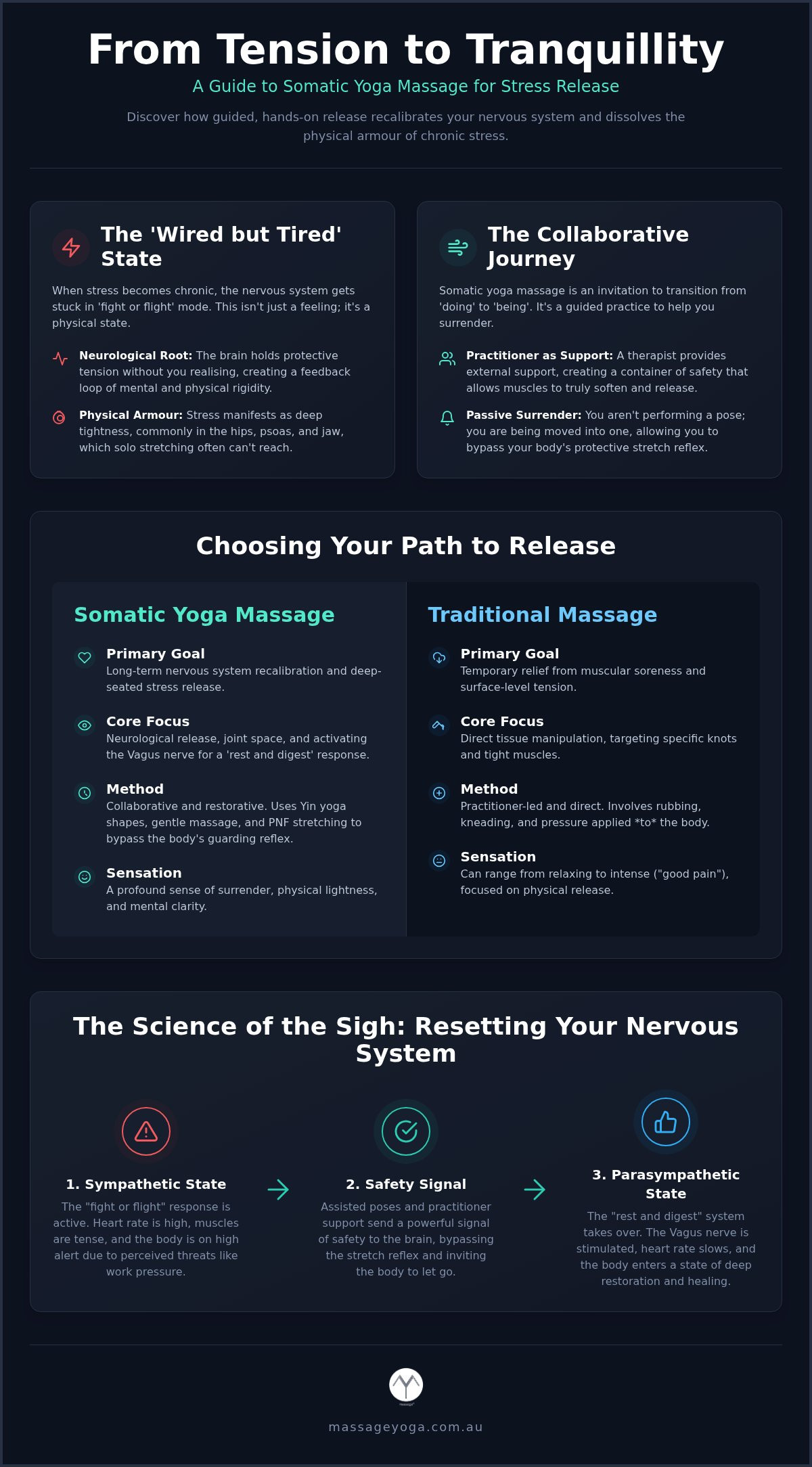
Imagine your body as a vessel that has slowly filled with the weight of daily demands. Somatic yoga massage for stress release is not another task for your to-do list; it's a collaborative practice where you finally stop doing and start being. In this space, a practitioner gently guides your body into deep, therapeutic positions rooted in Yin yoga. While you are held in these shapes, restorative massage is applied to encourage a deeper softening. It is a sensory immersion designed to recalibrate a tired system.

In the Australian wellness landscape, this approach is becoming a cornerstone for burnout recovery. We're seeing a shift away from high-intensity "fixes" toward restorative practices that respect the body's pace. The office-body, often characterised by a tight chest and rounded shoulders, carries years of stored pressure. A quick rub or a standard gym session might offer temporary relief, but it rarely addresses the neurological root of the tension. This assisted somatic work focuses on joint space and neurological length, allowing for a level of passive surrender that's impossible to achieve alone. If you feel ready to explore this path, you can book a session to begin your journey.

The Role of the Practitioner in Your Release

A skilled therapist acts as a mirror for your nervous system. They identify protective tension, those quiet areas where your brain is holding on without you even realising it. By providing external support, the practitioner creates a container of safety. This allows your muscles to truly soften; they no longer feel the need to guard against gravity or effort. You aren't performing a pose. You're being moved into one. Through expert leverage and compassionate positioning, you move beyond the physical limits of solo stretching into a space of complete presence.

This emphasis on professional guidance is shared by experts in the field; for instance, the therapeutic approach of Brigitte Lévesque demonstrates how skilled touch can help individuals navigate physical tension and rediscover a sense of calm.

Why Stress Manifests as Physical Rigidity

Our bodies are hardwired to respond to threats, but when the threat is a never-ending inbox or a frantic schedule, the fight or flight response stays "on". This stress has favourite hiding places, particularly the hips and psoas, where it creates a physical armour. To understand the depth of this connection, many look toward the principles of What is Somatic Experiencing?, which explores how stress becomes trapped in the nervous system. Chronic stress creates a feedback loop. Your mind feels rigid because your body is tight, and your body stays tight because your mind cannot rest. Recognising that your tension is neurological, rather than just postural, is the first step toward a soft exhale and lasting relief.

The Science of the Sigh: How Somatic Release Resets the Nervous System

The "sigh" is more than just a sound; it's a physiological release that signals the end of a threat. When you experience somatic yoga massage for stress release, you are actively inviting your body to exit the high-alert state of the sympathetic nervous system. This transition from "doing" to "being" allows your internal systems to shift their focus from survival to restoration. It is a profound recalibration that begins the moment you surrender to the support of a practitioner, allowing your heart rate to settle and your breath to deepen.

The stretch reflex is an automatic muscle contraction triggered by a sudden or deep lengthening, which assisted somatic work bypasses by using slow, supported movements to prevent the body from guarding against the stretch. To further support this neurological recalibration, you can learn more about targeted methods for releasing deep-seated structural tension.

Vagal Tone and Emotional Resilience

Deep, assisted poses act as a gentle massage for the Vagus nerve, the primary regulator of our rest-and-digest response. As heart rate slows and blood pressure settles, the brain receives a clear signal that the environment is safe. This physical opening is central to the science of somatic therapy, which highlights how our emotional resilience is tied to our physiological state. When the diaphragm is allowed to expand fully, anxiety often dissolves into the breath. A long, soft muscle is indeed a calm muscle.

PNF Stretching: The Secret to Neurological Release

In a restorative context, PNF (Proprioceptive Neuromuscular Facilitation) is a soulful technique for neurological re-education. By using the contract-relax method, a practitioner guides you through gentle resistance that helps the muscle discover a deeper, safer level of rest. This process bypasses the usual protective barriers, teaching the nervous system to accept a more spacious range of motion without fear. This makes somatic yoga massage for stress release a powerful tool for those who find standard massage only provides fleeting relief. While traditional massage manipulates tissue, this method resets the neurological length of the muscle, offering a sense of lightness that lasts. If you feel called to experience this level of release, you might find it helpful to explore our path to deep rest.

Somatic Yoga Massage vs. Traditional Massage: Choosing Your Path

You should prioritise assisted somatic release when you feel "stuck" in your body, unable to find mental clarity through traditional movement. It is a premium evolution of self-care that bypasses the brain's protective guarding. By focusing on joint space, this method provides a sense of physical lightness that traditional massage alone cannot always achieve. It is a gentle invitation to return to yourself.

When your system is flooded with cortisol, your brain’s primary goal is protection. In this state, attempting to stretch deeply on your own can feel like a battle against your own anatomy. Your muscles guard. Your mind remains busy, tracking alignment and timing. This research on Somatic stretching for stress relief explains how engaging the parasympathetic nervous system is essential for true lengthening. By removing the cognitive load of "how" to stretch, you allow yourself the luxury of being moved. The practitioner holds the weight, allowing you to finally descend into a state of deep, unhindered presence.

Synergy: When Massage and Restorative Yoga Intersect

The Massoga® approach honours the synergy between these two disciplines. During a long-held Yin pose, hands-on massage acts as a sensory cue, inviting specific areas to soften further. This integrated bodywork is particularly vital for trauma-sensitive nervous systems that require a high degree of safety and care. It creates a holistic sanctuary where the whole person is seen, not just a sore muscle. Soften. Sink. Surrender. These sensory directives guide the experience, helping you transition from the busyness of daily life into a state of deep immersion. If you are ready to experience this intersection, you can book a treatment to begin your journey toward profound restoration.

Somatic yoga massage for stress release

What to Expect: Preparing for Your Journey into Stillness

The moment you step into the treatment space, the process of somatic yoga massage for stress release begins. Soft lighting, the subtle scent of essential oils, and a carefully curated soundscape are not merely aesthetic choices. They are sensory cues that invite your nervous system to lower its guard. This environment creates a sanctuary where the external world fades, allowing you to focus entirely on your internal landscape and the sensations within. It is a transition from the busyness of the day into a state of profound presence.

To fully surrender, your physical preparation is key. Choose comfortable, non-restrictive clothing that allows for a full, unhindered range of motion. Breathable cotton or soft leggings are ideal, as they move with you during assisted poses. Before the session begins, take a moment to discuss your boundaries and your "edge" with your practitioner. This edge is the point where a stretch feels deep but still safe; communicating this ensures you never feel the need to tense against the movement. Safety is the foundation of every release.

Breathing into the Release

During your session, your breath becomes the bridge between your mind and body. Practise rhythmic breathing that mirrors the practitioner’s gentle movements. Rather than pushing through a pose to achieve a "better" stretch, focus on softening into the support provided. The exhale is your most powerful tool; it signals the brain to release the muscle and quiet the mental chatter. Let each breath be a slow, steady invitation to descend further into stillness. Soften. Sink. Surrender.

Post-Session Integration and Care

The 24 hours following a deep somatic release are a time for integration. You may experience an "afterglow", a state of profound physical lightness and mental clarity. However, releasing stored tension in the hips or chest can also trigger an emotional detox. Be gentle with yourself. Drink plenty of water to help your body process the physical changes and prioritise rest. If possible, organise your schedule to avoid immediate high-stress triggers or frantic environments. This space allows the neurological shifts to settle and become your new baseline for calm.

Massoga®: Australia’s Sanctuary for Assisted Somatic Release

Massoga® Massage Yoga is a sanctuary for those who have forgotten how to rest. It represents the premium evolution of somatic yoga massage for stress release, blending the ancient wisdom of Yin yoga with the nurturing touch of restorative massage. Since 2016, we have refined this integrated bodywork to serve as a bridge between physical tension and neurological peace. Our approach is intentionally trauma-sensitive, acknowledging that the body carries stories that require a gentle, expert hand to unlock. This is not a fast-paced flow. It is a slow, methodical return to yourself. By prioritising the internal state over physical performance, we create a space where your nervous system can finally lower its guard.

Retreat into Stillness: Magnetic Island and Beyond

The power of place is undeniable when seeking a total system reset. On the sun-drenched shores of Queensland, our Magnetic Island retreats facilitate a level of rest that is often impossible to find within the demands of daily life. Here, we combine the quietude of nature with restorative nourishment and our signature Massoga® sessions. It is a complete recalibration of the senses. Whether you are joining us in the tropical north or at our other national locations like the Otways, the goal remains the same: profound restoration. To understand why this intentional pause is so vital for your well-being, we invite you to explore The Art of Deep Rest. Stillness is not an indulgence; it is a biological necessity for the modern Australian.

Bringing the Sanctuary to You

We recognise that true restoration must also fit into the rhythm of your personal life. Through Massoga® at Home, we bring the sanctuary to you. These private treatments offer the convenience of professional assisted stretching and massage in your own private space. Every session is bespoke and meticulously tailored to your unique stress profile and physical needs. We look for the quiet signals of tension, the guarded breath, and the rigid posture, then guide you toward a soft, lasting exhale. Our practitioners provide the leverage and support your body needs to let go of what it no longer needs to carry. Take the first step toward surrender and Sign up to begin your journey to rest. Your nervous system will thank you for the space to simply be.

Your Invitation to Return to Stillness

You don't have to carry the weight of chronic tension alone. By choosing somatic yoga massage for stress release, you allow your body to bypass its protective guarding and finally descend into a state of profound peace. This collaborative path moves beyond the limitations of solo effort, offering a regulated nervous system and a deep sense of physical lightness. Whether you join us for a luxury retreat in one of Australia's most tranquil locations or a private treatment, our trauma-sensitive approach ensures you feel seen and cared for.

Expertly guided sessions by founder Wallis Murphy-Munn offer a sanctuary where the wisdom of Yin yoga meets the healing touch of restorative massage. It's a transition from the busyness of daily life into a state of deep presence. You've learned how the science of the sigh can reset your internal state; now it's time to experience that surrender firsthand.

Soften. Sink. Surrender. Your body is ready for the release it has been waiting for.

Frequently Asked Questions

Is somatic yoga massage better than a regular massage for stress?

Somatic yoga massage for stress release is often more effective for chronic tension because it addresses the neurological root of guarding. While a regular massage manipulates soft tissue, this integrated approach focuses on joint space and neurological length. It's a collaborative process where you finally stop "doing" and start "being". By bypassing the brain's protective tension, you can achieve a level of deep rest that a standard rub simply cannot reach.

Do I need to be flexible to try assisted somatic stretching?

You don't need any prior flexibility or yoga experience to benefit from these sessions. In fact, the practice is specifically designed for those who feel physically rigid or "stuck" in their bodies. Your practitioner guides you into every shape, supporting your weight and managing the leverage. This removes the cognitive load of stretching correctly, allowing you to focus entirely on the sensation of softening and the relief of being held.

What should I wear to a somatic yoga massage session?

It's best to wear soft, non-restrictive clothing that allows for a full range of motion. Think of what you might wear for a gentle restorative practice; leggings, trackpants, or breathable cotton t-shirts are ideal. Avoid items with heavy zippers, buttons, or restrictive waistbands that might interfere with your comfort as you are moved into different positions. This ensures your physical shell doesn't distract from the internal process of surrender.

How often should I have assisted stretching for long-term stress relief?

For long-term stress management, many find that a monthly private session or an annual immersive retreat provides the best results. While a single treatment offers immediate relief, regular somatic yoga massage for stress release helps to recalibrate your nervous system's baseline. It's about training your body to recognise safety and return to a state of rest more easily. This consistent practice prevents the cumulative build-up of the "wired but tired" feeling.

Can somatic release help with sleep and chronic insomnia?

Somatic release is a powerful tool for improving sleep quality and addressing chronic insomnia. By stimulating the Vagus nerve and activating the parasympathetic nervous system, these sessions signal your brain that it's safe to switch off. This physical and neurological shift often leads to a deeper, more restorative sleep cycle. Many clients report a significant reduction in the mental chatter that typically prevents them from drifting off after a busy day.

Is assisted stretching safe if I have a history of trauma?

Massoga® offers a specific Trauma Sensitive Massoga® treatment designed for this exact purpose. Safety and agency are the foundations of our work. Your practitioner will discuss your boundaries and edges before the session begins, ensuring you feel completely in control of the experience. This gentle, hands-on approach can be a profound way to reclaim a sense of safety within your own body, moving at a pace that respects your unique history.

What is the difference between Yin yoga and somatic assisted stretching?

While Yin yoga is typically a solo practice performed on a mat, somatic assisted stretching is a collaborative bodywork treatment. In a Massoga® session, you aren't performing the poses yourself; instead, a practitioner moves your body into therapeutic Yin positions while applying restorative massage. This synergy allows for a deeper level of passive surrender, as you don't have to use any muscular effort to maintain the shapes or track the timing.

Will I feel sore after a deep restorative somatic session?

It's rare to feel the typical "post-gym" muscle soreness after a restorative somatic session. Because the movements are passive and supported, your muscles aren't being strained through effort. You are more likely to experience a profound sense of physical lightness or what we call an "emotional detox". As deep-seated tension in the hips or chest is released, you might feel a quiet sense of clarity or a need for extra rest and hydration.


Comments


Written by Wallis Murphy-Munn

Wallis Murphy-Munn is the founder of Massoga®, a unique practice that combines the therapeutic benefits of massage with the restorative elements of Yin Yoga.


Her hands-on teaching approach has led to deeper relaxation for her students, inspiring the creation of Massoga®.


In addition to her practice, Wallis enjoys writing blog articles to share her insights, advocating for the importance of human touch and simple connections in an increasingly isolated world.

14.png

About

Yoga Retreats

Other Services 

  • Instagram
  • Facebook
  • LinkedIn

We acknowledge the traditional owners of the land in all the regions of the beautiful countries we travel to and experience on retreat. The custodians of Kulin Nation, in the regions of the Woiworung, Boonwurrung and Wathaurong People. The custodians of the Yunbenun of the Wulgurukaba People. We acknowledge their Ancestors past, present and future who nurtured and cared for Country for tens of thousands of years.

© 2025 Massoga® Massage Yoga | Website by Insight Culture

bottom of page