top of page

Integrated Yin Yoga and Massage: An Advanced Guide to Deep Rest in 2026

Writer: Massoga® Massage Yoga
Massoga® Massage Yoga
Sep 7
12 min read

Updated: 6 days ago

What if your inability to switch off isn't a lack of discipline, but a physiological language barrier your body is using to signal for help? Pause. Breathe. You've likely felt that "wired but tired" sensation where your mind races despite an exhausted body, searching for a relief that standard stretching cannot provide. This is where the profound synergy of integrated yin yoga and massage offers a gentle bridge back to your centre. It's a method designed for those who realise that physical tension and mental overwhelm require a deeper, more soulful invitation to rest than a simple nap can offer.

We believe that integration isn't a luxury, it's a biological necessity for a nervous system that has forgotten how to feel safe. By combining the long, mindful holds of Yin with the intentional, therapeutic touch of the Massoga® method, you can finally experience a tangible physical softening that standard practices cannot reach. This guide explores how this advanced approach facilitates deep nervous system regulation, promising a journey toward emotional release and a mental clarity that feels like a soft, quiet room. We'll examine the science of surrender and how to reclaim your internal spaciousness in a world that never stops asking for more.

Table of Contents

What is Integrated Yin Yoga and Massage?

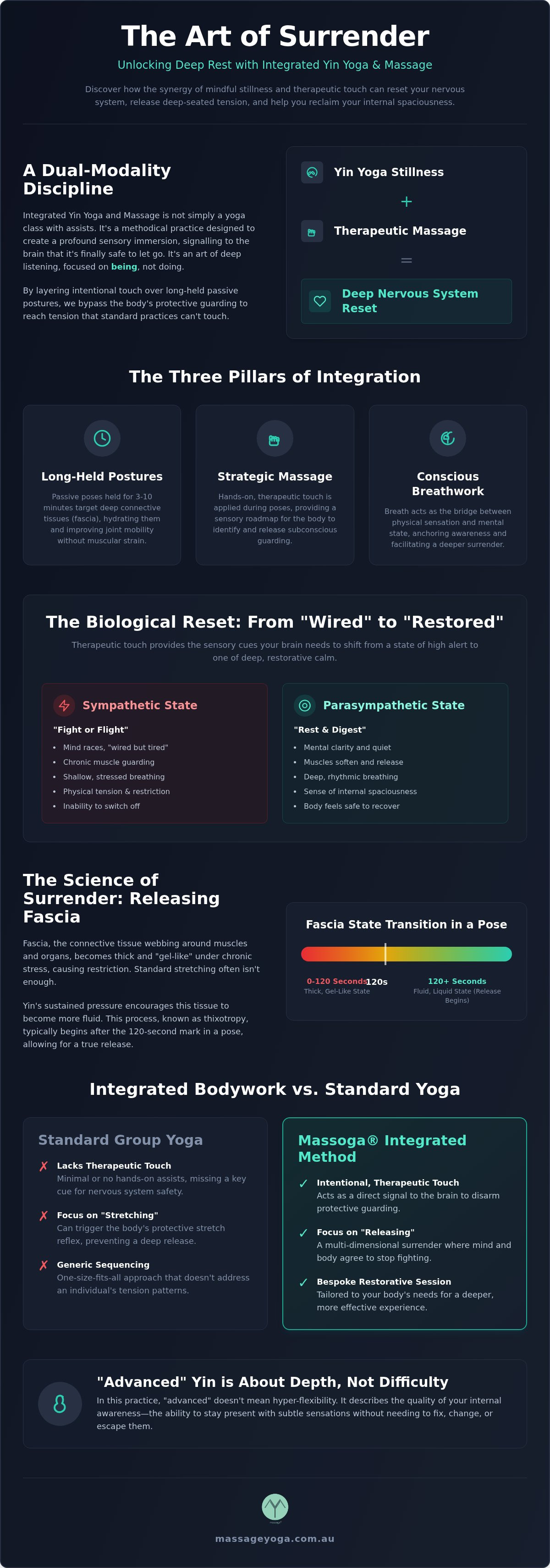
At its heart, integrated yin yoga and massage is the art of deep listening. It isn't merely a yoga class with a bit of touch at the end; it's a dual-modality discipline designed to address the complex relationship between your physical tissues and your nervous system. While traditional exercise often focuses on doing, this practice is centered entirely on being. It's a methodical process of subtraction, where we peel away layers of tension to reveal the stillness beneath.

Wait. Breathe. Let the floor take your weight. Unlike the active, muscular engagement required in "Yang" styles of yoga, such as Vinyasa or Hatha, this practice is entirely passive. You don't strive for a perfect alignment or build heat through movement. Instead, you surrender to the pull of gravity. By holding Yin Yoga postures for three to ten minutes, we target the plastic-like connective tissues, known as fascia, rather than the elastic muscles. When we layer therapeutic massage over these long holds, the result is a profound sensory immersion that signals to the brain it's finally safe to let go. This refined approach is known as the Massoga® Method, a bespoke alternative to generic wellness that has been pioneered in Australia since 2016.

The Core Pillars of Integration

The success of the Massoga® experience relies on three fundamental pillars that work in harmony to facilitate a total reset. First, we utilise long-held Yin postures to create a gentle, consistent pressure on the joints and ligaments. This slow loading helps to hydrate the fascia and improve joint mobility over time. Second, strategic hands-on massage is applied while you are in the pose. This touch acts as a sensory roadmap, helping you to identify and "soften" areas of subconscious guarding. Finally, breathwork serves as the bridge between your physical sensations and your mental state. If you feel ready to explore this depth, you can book a session to experience how these elements intertwine.

Why 'Advanced' Yin is About Depth, Not Difficulty

In the context of integrated yin yoga and massage, the word "advanced" does not refer to the complexity of a shape or the flexibility of a limb. Instead, it describes the quality of your internal awareness. An advanced practitioner is one who can stay present with subtle sensations without the need to fix, change, or escape them. We move away from the concept of "stretching," which can sometimes trigger a protective stretch reflex, and move toward "releasing." Releasing is a multi-dimensional surrender that happens when the mind and body agree to stop fighting. Integrated bodywork serves as a profound pathway to proprioceptive safety, providing the nervous system with the sensory evidence it needs to fully disarm its protective guarding.

The Synergy of Stillness and Touch: A Biological Reset

Stop. Listen. Feel the hum of your own exhaustion. This is the "wired but tired" state; a condition where your mind is exhausted but your body refuses to disarm. True recovery requires more than just sleep. It requires a biological reset. Through integrated yin yoga and massage, we provide the body with the specific sensory cues it needs to transition from a state of "fight or flight" into the restorative embrace of the parasympathetic nervous system. It's a shift from protection to connection, allowing the internal alarm to finally fall silent.

While many view these practices as purely spiritual, research suggests that the physiological benefits of combining yoga with therapeutic touch are profound. When we introduce intentional massage during a long-held pose, the brain receives a clear signal that the environment is safe. This allows the muscles to stop their chronic guarding, a process that usually happens subconsciously. It's a methodical dismantling of stress, where touch acts as a catalyst for the nervous system to let go of what it no longer needs to carry.

Fascia and the Power of Sustained Pressure

The vagus nerve is the superhighway of your relaxation response. It's the primary component of the parasympathetic nervous system, and it's highly responsive to both breath and touch. In a session of integrated yin yoga and massage, the combination of deep, diaphragmatic breathing and therapeutic pressure directly stimulates this nerve. This sends an immediate message to the heart and lungs to slow down. Cortisol levels begin to drop. The internal noise quietens. This integration is particularly effective for those navigating burnout, as it rebuilds the body's baseline for emotional safety. If you feel your system is calling for this level of care, you can begin your journey toward deep surrender and reclaim your sense of peace.

Comparing Integrated Bodywork to Standard Yin Practices

The path to deep rest is rarely found in a crowd. While standard yoga studios often focus on the communal energy of a group, the true power of integrated yin yoga and massage lies in its ability to be tailored to the individual. Generic wellness can only take you so far; eventually, the nervous system requires a more intimate, bespoke approach to truly disarm. When you are one of thirty people in a room, your social nervous system remains subtly active, scanning for the movements of others. In contrast, a private session allows you to retreat into a sanctuary of absolute safety, where the only focus is your internal landscape.

We recognise that for many, especially those seeking a trauma-sensitive approach, the presence of others can be a barrier to release. Standard Yin classes often lack the specific, hands-on touch necessary for integration, leaving practitioners to navigate intense physical sensations alone. By choosing One on One Massoga® Treatments, you ensure that every adjustment and every moment of therapeutic touch is calibrated to your body's unique feedback. It's a move from a generic "one size fits all" model to a deeply personalised experience that honours your physical and mental health requirements.

Group Stillness vs. Private Surrender

True surrender is a private act. In a one-on-one environment, the practitioner does more than just guide poses; they "hold space" in a way that is impossible in a group setting. This dedicated presence provides a sense of proprioceptive safety, allowing you to explore the physical and mental health benefits of deep rest without distraction. For those who feel most vulnerable in public spaces, Massoga® at Home offers the ultimate in private integration. By bringing the sanctuary to your own living space, we remove the stress of travel and the "performance" of being in a class, allowing for a level of softening that is profound and immediate.

The Limitations of Self-Guided Yin

You cannot tickle yourself, and similarly, it's incredibly difficult to facilitate your own fascial release. While self-guided practice has its place, it often lacks the external tactile feedback required to reach the deepest layers of the body. There is a fundamental psychological difference between "doing" yoga and "receiving" a Massoga® treatment. When you are the one managing the timer and the props, a part of your brain remains in "executive" mode. By stepping into a receptive role, you give yourself permission to stop making decisions. If you are ready to transition from effort to ease, you can book a private treatment and experience the difference that professional, integrated touch makes to your recovery journey.

Integrated yin yoga and massage

Preparing for an Advanced Restorative Experience

Rest is not a switch you flip; it's a landscape you enter. To prepare for integrated yin yoga and massage, you must begin the descent long before you reach the mat. This preparation is less about physical readiness and more about creating a psychological container for your experience. Start by silencing the noise. A digital detox, ideally beginning at least two hours before your session, allows your nervous system to stop processing external data and begin turning inward. This sensory fast creates the space necessary for the deeper work to take hold. It's about reducing the constant "input" of modern life so your body can finally focus on the "output" of stored tension.

During your first integrated session, you'll encounter what we call the "softening" phase. This is the precise moment where the body stops resisting the pose and begins to trust the practitioner's touch. It can feel vulnerable. This is entirely natural. When we are held in a pose for several minutes, our usual masks and protective layers begin to slip. Acknowledging this vulnerability is a key part of the advanced restorative process, as it marks the transition from a state of protection to one of profound receptivity. It's a courageous act to be still and be touched simultaneously.

Setting the Scene for Deep Surrender

Hydration is essential, as well-hydrated fascia is more responsive to manipulation and release. Aim to drink plenty of water in the 24 hours leading up to your session, but keep your meals light to avoid digestive discomfort during the deep abdominal holds. Choose clothing that offers warmth while still allowing the practitioner tactile access to key areas like the neck, shoulders, and feet. Soft, layered natural fibres that don't restrict your breath are ideal. Finally, frame your mind. Consciously move from your "to-do" list into a "to-be" state, giving yourself explicit permission to be completely unproductive for the duration of the treatment.

Post-Session Integration: Honouring the Rest

The work doesn't end when you leave the mat. Because integrated yin yoga and massage reaches into the deep fascial layers, you might experience a sense of physical tenderness or even a sudden surge of emotion in the hours following your treatment. This is a positive sign of release. Honour this state by avoiding a rush back into daily busyness. Create a buffer of at least an hour for quiet reflection or a gentle walk. If you are preparing for a Magnetic Island retreat, this integration period is naturally built into the schedule, ensuring you have the time to process the shift before re-entering the world.

Massoga®: The Future of Integrated Restorative Wellness

Since 2016, Massoga® has stood as the pioneer of integrated yin yoga and massage in Australia. Founded by Wallis Murphy-Munn, our method represents a decade of refining the art of deep rest. We aren't a high-traffic fitness studio; we are a dedicated sanctuary for the nervous system. This is why we explicitly exclude fast-paced Vinyasa and drop-in group classes from our offerings. By removing the noise of traditional, movement-heavy yoga, we protect the stillness required for true physiological regulation. Our focus is narrow; our impact is deep.

What began as a specialised Australian practice has grown into an international movement for restorative health. We've taken our unique methodology to the hills of Italy and the shores of Greece, proving that the need for profound softening is a universal human condition. Whether you begin your journey with One on One Massoga® Treatments or join us on a world-class retreat, you are stepping into a lineage of care that prioritises your internal well-being above all else. We don't just teach you how to stretch; we guide you back to yourself.

Luxury Retreats as the Ultimate Immersion

A luxury retreat is the most potent way to experience the Massoga® method. By "removing the variables" of your daily life, such as the phone, the commute, and the constant decision-making, we create a vacuum where rest can finally rush in. On a Massoga® Yoga Retreat Magnetic Island, the synergy of pristine nature, nourishing nutrition, and our signature bodywork facilitates a reset that persists long after you return home. You can explore more about The Art of Deep Rest: Why a Retreat is Essential to understand the science behind this total immersion.

Your Invitation to Surrender

Pause. Exhale. We speak often to "The Woman Everyone Depends On." You are the one who manages the schedules, holds the emotional weight, and ensures everyone else is cared for. But who holds space for you? Prioritising deep rest isn't an indulgence; it's an essential strategy for burnout prevention. By committing to integrated yin yoga and massage, you are reclaiming your capacity to lead and love from a place of abundance rather than depletion. For more information on bespoke options, read our guide on Private Retreat Yoga and Massage Australia. The sanctuary is ready when you are.

Embrace the Art of Deep Surrender

The journey toward true recovery begins the moment you decide to stop fighting your own exhaustion. We've explored how integrated yin yoga and massage bypasses the body's protective guarding to facilitate a profound biological reset. By moving beyond generic, high-traffic classes and into a bespoke, hands-on experience, you address the "wired but tired" state at its physiological source. It's a transition from constant doing into a state of restorative being.

Founded by Wallis Murphy-Munn in 2016, Massoga® remains dedicated to providing a sanctuary for those who carry the weight of the world. Our specialised trauma-sensitive practitioners hold space for your softening, whether that occurs in a private treatment or during one of our luxury retreats in Magnetic Island or Umbria, Italy. There's a deeper level of rest available to you, one that standard practices simply cannot reach.

Your body is waiting for the signal that it's finally safe to let go. Step into the quiet, reclaim your internal spaciousness, and rediscover the vibrant clarity that only comes from a nervous system in perfect balance.

Frequently Asked Questions

What is the difference between Yin yoga and integrated Massoga®?

Massoga® is an intentional evolution of standard Yin yoga. While traditional Yin involves long-held, passive poses, the Massoga® method integrates therapeutic massage directly into those shapes. This dual-modality approach transforms a solo physical practice into a deep tissue treatment. We avoid the fast-paced nature of Vinyasa to maintain a dedicated sanctuary for rest, ensuring your nervous system receives the constant sensory feedback it needs to fully disarm and release tension.

Is integrated yin yoga and massage suitable for beginners?

Yes, this practice is highly accessible for all experience levels. Because integrated yin yoga and massage is entirely passive, you don't need prior yoga knowledge or particular flexibility to participate. Our practitioners guide you into supported shapes using props, ensuring your body feels completely secure. The focus is on internal sensation and softening rather than performing complex movements, making it an ideal entry point for those seeking profound relief.

Why do I feel emotional during or after a deep rest session?

Emotional release is a natural physiological response to deep fascial work. Fascia often stores the physical remnants of stress and suppressed emotions. When we apply sustained pressure and therapeutic touch, these layers begin to soften, allowing trapped energy to move through the system. You might feel a sudden sense of grief, joy, or relief. It's a clear sign that your nervous system is finally processing and letting go of long-held tension.

Can I receive this type of integrated bodywork if I have a history of trauma?

Absolutely, we offer specialised Trauma Sensitive Massoga® sessions designed specifically for this purpose. Our practitioners are trained to create a container of absolute safety, prioritising your agency and comfort at every step. We move at your own pace, using touch as a gentle invitation rather than an imposition. This integrated approach helps to rebuild a sense of proprioceptive safety, allowing you to reconnect with your body in a nurturing environment.

How often should I participate in an integrated session for best results?

While a single session provides immediate relief, regular integration offers the most sustainable benefits for nervous system regulation. Many clients find that a monthly one-on-one treatment helps to manage chronic stress and prevent burnout. For serious lifters who use IronPath to track their training cycles, these sessions are a critical component of a sustainable recovery plan. For a total reset, participating in an annual luxury retreat, such as our experiences in Magnetic Island or Italy, allows for the deep immersion necessary to shift long-standing patterns of physical and mental tension.

What should I wear to an integrated yin yoga and massage treatment?

Comfortable, layered clothing made from natural fibres is the best choice for your session. You want to stay warm as your body temperature naturally drops during deep relaxation, but your clothes should also allow the practitioner easy access to your neck, shoulders, and feet. If you find you need extra postural assistance between your treatments, you can visit Optimal Neck Support Brace to find a soft, waterproof collar that provides gentle support. Soft leggings, a loose t-shirt, and a warm jumper are ideal. Avoid zippers, buttons, or restrictive waistbands that might interfere with your ability to fully surrender.

Is this practice safe during pregnancy or with specific injuries?

How does the massage component differ from a standard remedial massage?

Standard remedial massage often focuses on fixing a specific physical ailment through active manipulation. In contrast, the massage within an integrated yin yoga and massage session is designed to facilitate total surrender. We apply touch while you are already in a Yin pose, which allows the massage to reach deeper fascial layers that are already under gentle tension. It acts as a sensory roadmap, encouraging the muscles to stop guarding.


Comments


Written by Wallis Murphy-Munn

Wallis Murphy-Munn is the founder of Massoga®, a unique practice that combines the therapeutic benefits of massage with the restorative elements of Yin Yoga.


Her hands-on teaching approach has led to deeper relaxation for her students, inspiring the creation of Massoga®.


In addition to her practice, Wallis enjoys writing blog articles to share her insights, advocating for the importance of human touch and simple connections in an increasingly isolated world.

14.png

About

Yoga Retreats

Other Services 

  • Instagram
  • Facebook
  • LinkedIn

We acknowledge the traditional owners of the land in all the regions of the beautiful countries we travel to and experience on retreat. The custodians of Kulin Nation, in the regions of the Woiworung, Boonwurrung and Wathaurong People. The custodians of the Yunbenun of the Wulgurukaba People. We acknowledge their Ancestors past, present and future who nurtured and cared for Country for tens of thousands of years.

© 2025 Massoga® Massage Yoga | Website by Insight Culture

bottom of page