top of page

Healing Through Stillness: Private Trauma Sensitive Yoga Massage in Melbourne and Beyond

  • Writer: Massoga® Massage Yoga
    Massoga® Massage Yoga
  • Aug 25
  • 13 min read

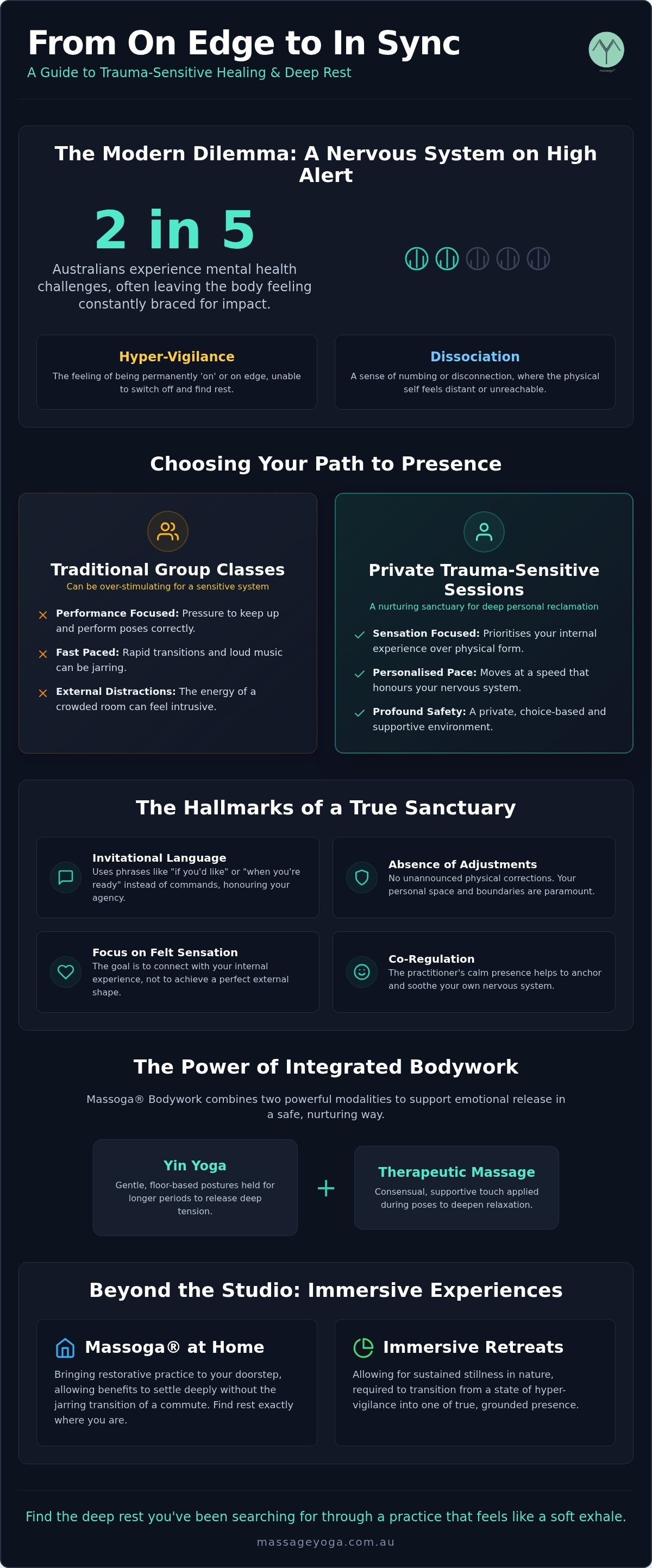
What if the very practice meant to heal you actually leaves you feeling exposed or hyper-vigilant? For many, the fast-paced energy of a crowded group fitness studio can feel like a threat rather than a sanctuary. With two in five Australians experiencing mental health challenges, it's common to feel permanently on edge, unable to quiet the internal alarm that keeps you disconnected from your physical self. Engaging in a private trauma sensitive yoga massage session offers a profound shift in perspective, moving away from performance and toward a deeply personal reclamation of safety.

Softly arrive. Feel the breath. It's exhausting to live in a body that feels like it's constantly braced for impact. We realise that true restoration isn't a task to be checked off; it's a slow, consensual unfolding that honours your unique boundaries and internal pace. This article explores how integrated bodywork and specialised yoga provide a safer, more nurturing path to nervous system regulation than traditional classes. You'll discover how to transition from a state of dissociation into one of grounded presence, finding the deep rest you've been searching for through a practice that finally feels like a soft exhale.

Key Takeaways

  • Understand how prioritising internal sensation over physical form helps to soothe a nervous system that feels permanently on edge.

  • Discover why a private trauma sensitive yoga massage Melbourne session provides the tailored pace and sanctuary needed for deep, personal reclamation.

  • Learn how integrated bodywork combines Yin yoga with consensual, therapeutic massage to support emotional release in a safe, nurturing way.

  • Identify the hallmarks of a trauma-sensitive environment, from the use of invitational language to the absence of unannounced physical adjustments.

  • Realise how immersive retreats in nature allow for the sustained stillness required to transition from hyper-vigilance into a state of true presence.

Table of Contents

What is Trauma-Sensitive Yoga and Why Does It Matter?

Breathe in. Notice the weight of your body against the floor. Trauma-sensitive yoga is less about the shape you make with your limbs and more about the quiet conversation you have with your internal self. It prioritises the felt experience over physical perfection. For those living with the echoes of past experiences, the nervous system often resides in a state of hyper-vigilance; a "permanent on" that leaves the body braced for a threat that isn't there. Alternatively, you might feel a sense of dissociation, a quiet numbing where the physical self feels distant or unreachable. These are natural responses to stress, yet they can become a heavy burden to carry through daily life.

Traditional Vinyasa flow, with its rapid transitions and loud music, can often be over-stimulating for a sensitive system. It demands performance and synchronisation. In contrast, a private trauma sensitive yoga massage Melbourne session creates a container of profound safety. It's a space where you aren't told what to do, but are invited to explore what feels right for you in this exact moment. Within the Australian wellness landscape, this choice-based approach is a vital shift toward trauma-informed care that honours individual agency and personal space.

The Shift from Performance to Presence

Soften your shoulders. In this space, invitational language is the foundation of every movement. Instead of commands, you'll hear invitations to move "if you'd like" or "when you're ready." This simple shift allows you to reclaim agency over your body. There are no unannounced physical adjustments or corrections here. By removing the pressure to "do it right," your parasympathetic nervous system finally receives the signal that it's safe to settle. True stillness isn't forced; it's allowed to emerge naturally when the heart rate slows and the breath deepens into a steady, calming rhythm.

Common Signs You Might Benefit from a Sensitive Practice

You might be the woman everyone depends on, the one who holds everything together but finds it impossible to hold herself. If you find it difficult to switch off after a long day or feel exhausted despite a full night's sleep, your system may be stuck in a cycle of high arousal. Many people feel overwhelmed in noisy group environments or busy studios where the energy of others feels intrusive. A sensitive practice offers a path to deep rest that feels supported and entirely free from external judgment. It's for anyone seeking a sanctuary where they can finally let go of the need to be "on" and simply exist in a state of nurturing presence.

Comparing Group Classes vs. Private One-on-One Sessions

Choosing between a group environment and a private setting is a deeply personal decision. Group classes can provide a sense of shared humanity and a lower entry cost for those beginning their journey. However, for many, the presence of others can be a source of unintended noise or visual distraction. A one on one yoga session removes these external variables. It allows the practice to become a mirror of your immediate needs, moving at a pace that respects your nervous system's capacity to process sensation. Within a private trauma sensitive yoga massage Melbourne experience, the practitioner is entirely present for you, facilitating a level of integration between movement and touch that simply isn't possible in a room full of people.

For some, the highest level of safety is found within the familiar walls of their own residence. Massoga® Massage Yoga brings its restorative 'Massoga® at Home' practice to your doorstep, ensuring you don't have to navigate the outside world before or after your treatment. This allows the benefits of the integrated bodywork to settle more deeply into your system without the jarring transition of a commute. It's a soulful invitation to rest exactly where you are, supported by a practitioner who understands the unique requirements of a sensitive nervous system.

Why Privacy is Paramount for Deep Restoration

Exhale. Release the need to look a certain way. In a private space, the social pressure to perform or keep up with a sequence dissolves. You are free to be exactly as you are. This dedicated environment allows your practitioner to co-regulate with you, using their calm presence to help anchor your own. Every sensory detail is adjustable. We can soften the lighting, choose a specific soundscape, or ensure the room temperature is perfectly cocoon-like. These small adjustments signal to your brain that it's safe to surrender.

Which Path is Right for You?

Reflect on your current energy. Are you craving the quiet hum of community, or does your soul need deep, uninterrupted seclusion? Your preference for touch also matters. Private sessions allow for a nuanced conversation about hands-on support, ensuring every point of contact is consensual and nurturing. If you find yourself caught between the two, the Magnetic Island retreat offers a beautiful hybrid. It provides the warmth of a shared experience with ample space for personal reflection and deep rest. If you feel a call to begin this journey, you might explore our path to restorative rest.

The Role of Touch: Clinical TCTSY vs. Integrated Massoga® Bodywork

Soften your jaw. Feel the support of the earth beneath you. In the landscape of trauma recovery, there are many paths to reclaiming a sense of safety. Clinical models, such as Trauma Center Trauma Sensitive Yoga (TCTSY), often utilise a strictly no-touch approach. This standard exists to ensure absolute agency for the participant, removing any possibility of uninvited physical contact that could trigger a stress response. For many, this clinical boundary is a vital first step in feeling secure. However, as the nervous system begins to settle, some find that a lack of touch can reinforce a sense of being disconnected or "off-limits." This is where the integration of movement and therapeutic massage offers a different, more nurturing dimension of healing.

In a private trauma sensitive yoga massage Melbourne session, the focus shifts from clinical intervention to a soulful, integrated experience. We combine the stillness of Yin yoga with the restorative power of hands-on bodywork. Rather than just performing a pose, you are "held" within it. Imagine resting in a supported butterfly pose while a practitioner applies gentle, rhythmic pressure to your shoulders or feet. This combination allows for a level of surrender that movement alone often cannot reach. It's a transition from doing a practice to truly being within the experience.

The Power of Consensual, Nurturing Touch

Breathe deep into the belly. When touch is delivered with clear, established boundaries, it becomes a powerful tool for releasing stored tension in the fascia and muscles. Before we begin, a thorough consultation ensures your touch boundaries are clearly understood and honoured. We discuss which areas feel safe and which are to remain untouched. Consensual touch in a trauma-informed setting acts as a sensory anchor, reminding the body it is safe to soften. This physical reassurance helps to quiet the mind's internal alarm, allowing the parasympathetic nervous system to take the lead.

Reclaiming the Body Through Sensation

Many who have experienced trauma describe a feeling of "having a body" rather than "being a body." It feels like an object to be managed rather than a home to inhabit. Integrated massage techniques help bridge this gap by bringing awareness back to physical sensation in a way that feels quiet and supported. Hands-on support facilitates a deeper "exhale" for the soul, helping you move through layers of bracing that you may not even realise you are holding. If you are curious about how this specific approach differs from traditional massage, you can learn more about trauma informed massage therapy and its role in deep restoration.

Private trauma sensitive yoga massage Melbourne

Creating a Sanctuary: A Checklist for Choosing a Practice

Finding a practitioner who truly understands the delicate architecture of a sensitive nervous system is an act of self-honouring. It's about more than just a certificate on a wall. It's about the feeling that washes over you the moment you step through the door. Selecting a private trauma sensitive yoga massage Melbourne provider requires a discerning eye for detail. You are looking for a space where your agency is the highest priority and where the rhythm of the session is dictated by your breath, not a pre-set timer. This discernment ensures that your time spent in stillness is genuinely restorative rather than another task to be managed.

  • Invitational Language: Listen closely to how instructions are offered. A trauma-informed practitioner uses invitations rather than commands. They might say, "if you'd like, you can lower your gaze," instead of "close your eyes." This subtle shift returns the power of choice to you.

  • The Quality of the Environment: Consider if the space feels like a sanctuary. A quiet, boutique setting offers a level of containment that commercial studios or busy gyms cannot provide. Privacy is essential for allowing the deeper layers of the self to soften and release.

  • The Luxury of Pace: Nervous system regulation cannot be rushed. Ensure there is ample space between poses. This "gap" allows your system to process sensations and settle into a state of parasympathetic dominance before moving to the next shape.

Questions to Ask Your Potential Practitioner

Don't be afraid to ask direct questions before booking. A dedicated practitioner will welcome your curiosity. You might ask how they handle touch and consent; do they have a clear process for establishing boundaries? Inquire about their approach to stillness versus movement. If you're feeling particularly overwhelmed or tired on the day of your session, can the practice be adapted to meet you where you are? A truly sensitive practice is fluid, not rigid.

The Importance of the Physical Space

The environment acts as a silent co-regulator. Boutique settings are purposefully designed to minimise sensory overload, using soft lighting and intentional soundscapes to build trust. Within these walls, props like weighted bolsters and heavy blankets aren't just for comfort; they provide physical containment. This "nesting" helps the brain realise that the body is protected, allowing for a more profound surrender. To understand how every detail of the environment contributes to your recovery, you can explore the elements of a mindful bodywork session.

Beyond the Studio: The Immersive Retreat Experience

Arrive. Unpack. Let go. While a weekly practice offers a necessary pause, a multi-day retreat facilitates a profound shift that a single hour cannot always reach. It allows for sustained parasympathetic dominance, the state where the body's repair mechanisms finally take the lead. In a private trauma sensitive yoga massage Melbourne treatment, you begin the work of settling the mind. On a retreat, you live within that settlement. Nature acts as a powerful co-regulator in this process. The rhythmic sound of the ocean or the quiet hum of the Australian bush provides a steady sensory backdrop that signals safety to the primitive brain, allowing the internal alarm to finally go silent.

Luxury and comfort are not mere indulgences; they are essential cues of safety for a sensitive or traumatised system. When every detail is considered, from the softness of the linen to the nourishing meals prepared with care, the brain receives a clear message: you are protected. You are held. For those navigating burnout recovery, this removal of daily decision-making is a radical form of medicine. It allows the "The Woman Everyone Depends On" to step out of her role as a provider and into the role of the nurtured. This immersive experience is the ultimate soft exhale, providing the space required for a total nervous system reset.

The Science of a Respite Retreat

Deep restoration requires the removal of modern stressors. By stepping away from the digital hum and the demands of daily life, you allow your adrenal glands and nervous system to descend from a state of high alert. A respite retreat combines healthy nourishment, intentional silence, and integrated bodywork to create a holistic environment for healing. This sustained period of stillness helps to rewrite the body's stress response, moving you closer to a baseline of peace. To understand the broader context of this approach, you can explore our guide on Healing Through Stillness.

Booking Your Path to Restoration

Your journey toward deep rest is waiting. Our 2026 retreat calendar includes dedicated immersions at Magnetic Island and within the tranquil surroundings of the Otways. Each location is chosen for its ability to foster a sense of sanctuary and connection to the earth. If a multi-day retreat feels like too big a first step, we encourage you to begin with a private one-on-one session to build your sense of safety and comfort with the practice. Whether you seek the seclusion of the bush or the warmth of the coast, we are here to guide you back to yourself.

Embracing the Stillness Within

Reclaiming a sense of safety is a courageous act of self-care. It's about moving from a state of constant bracing to one of soft surrender. By choosing a private trauma sensitive yoga massage Melbourne session, you allow your nervous system the space it needs to settle without the noise of the outside world. Since 2016, we have specialised in this integrated approach, offering a unique blend of Yin yoga and nurturing bodywork designed specifically for the woman everyone depends on. You deserve a space where your boundaries are honoured and your well-being is the only priority.

Whether you begin with a session at home or eventually join us for a luxury retreat across Australia or Europe, each experience is tailored to your unique internal pace. True healing doesn't happen in a rush; it unfolds in the quiet, supported moments of presence. Trust that your body knows the way back to peace when it's given the right environment to flourish. We invite you to step away from the busyness of daily life and into a narrative of profound restoration.

You're not alone on this journey. We are here to provide the steady, compassionate support you need to feel grounded once more.

Frequently Asked Questions

Is trauma-sensitive yoga only for people with diagnosed PTSD?

Trauma-sensitive yoga is beneficial for anyone experiencing a heightened state of stress, not just those with a clinical PTSD diagnosis. Many of our clients are high-achieving women who feel permanently on or disconnected from their physical selves. If you experience hyper-vigilance, general anxiety, or a sense of being overwhelmed by modern life, this practice offers a sanctuary. It's about providing a safe space to regulate your nervous system, regardless of whether you have a formal diagnosis.

Can I do a one-on-one yoga session if I have never done yoga before?

You don't need any prior experience to benefit from a one on one yoga session. In fact, starting your journey in a private setting is often ideal. It removes the pressure to keep up with a group or perform complex poses. We focus on gentle, restorative Yin shapes that are accessible to every body. Your practitioner will guide you through each movement with care, ensuring you feel supported and comfortable at every stage of the practice.

How is Massoga® different from a normal massage or a normal yoga class?

Massoga® is a unique fusion of restorative Yin yoga and integrated bodywork that differs significantly from a standard yoga class or a clinical massage. We explicitly avoid fast-paced vinyasa or the drop-in culture of busy studios. Instead, you are held in supportive poses while receiving consensual, therapeutic touch. This combination allows for a deeper level of surrender and nervous system regulation than movement or massage can achieve in isolation. It's a holistic immersion into stillness.

What if I feel triggered or emotional during a session?

Feeling emotional or triggered is a natural part of the healing process; our space is designed to hold these experiences with compassion. Your practitioner is trained to recognise signs of nervous system arousal and will use invitational language to help you navigate the moment. You always have the agency to pause, change position, or stop the session entirely. There is no judgment here; only a gentle, professional presence to help you return to a state of safety.

Do I have to be touched during a trauma-sensitive bodywork session?

Physical touch is never a requirement in our sessions. While integrated bodywork is a core part of the Massoga® experience, we prioritise your comfort and consent above all else. During your initial consultation for a private trauma sensitive yoga massage Melbourne treatment, we establish clear boundaries regarding touch. If you prefer a no-touch practice, we will honour that completely, focusing purely on the restorative yoga and your internal sense of grounding and safety.

How many sessions will I need before I feel a difference in my nervous system?

Many clients report an immediate sense of relief and a soft exhale after their very first session. However, long-term nervous system regulation often requires consistent practice to retrain the body's stress response. You might find that a series of weekly or fortnightly treatments helps to build a sustainable foundation of peace. Every individual is different, and we encourage you to listen to your body's unique rhythm as you decide on the frequency of your visits.

Can trauma-sensitive yoga help with chronic fatigue or burnout?

Yes, this practice is specifically designed to support those navigating the heavy weight of burnout and chronic fatigue. By moving into the parasympathetic nervous system, we allow the adrenal glands to rest and the body to begin its natural repair processes. A private trauma sensitive yoga massage Melbourne session offers the deep, uninterrupted stillness required to address the root of exhaustion. It's an invitation to step out of doing mode and into restorative being.

What should I wear to a private Massoga® treatment?

We recommend wearing soft, comfortable clothing that allows you to move freely and stay warm. Think of loose-fitting yoga pants, leggings, or tracksuits paired with a comfortable top and warm socks. Since the practice involves long periods of stillness, your body temperature may drop slightly as you relax. We provide blankets and bolsters for extra comfort, but wearing layers ensures you can adjust your temperature easily to maintain a sense of cocoon-like safety throughout the session.


Comments


Written by Wallis Murphy-Munn

Wallis Murphy-Munn is the founder of Massoga®, a unique practice that combines the therapeutic benefits of massage with the restorative elements of Yin Yoga.


Her hands-on teaching approach has led to deeper relaxation for her students, inspiring the creation of Massoga®.


In addition to her practice, Wallis enjoys writing blog articles to share her insights, advocating for the importance of human touch and simple connections in an increasingly isolated world.

14.png

About

Yoga Retreats

Other Services 

  • Instagram
  • Facebook
  • LinkedIn

We acknowledge the traditional owners of the land in all the regions of the beautiful countries we travel to and experience on retreat. The custodians of Kulin Nation, in the regions of the Woiworung, Boonwurrung and Wathaurong People. The custodians of the Yunbenun of the Wulgurukaba People. We acknowledge their Ancestors past, present and future who nurtured and cared for Country for tens of thousands of years.

© 2025 Massoga® Massage Yoga | Website by Insight Culture

bottom of page