top of page

Healing Through Stillness: A Guide to Trauma Sensitive Yoga in Australia

  • Writer: Massoga® Massage Yoga
    Massoga® Massage Yoga
  • Aug 22
  • 12 min read

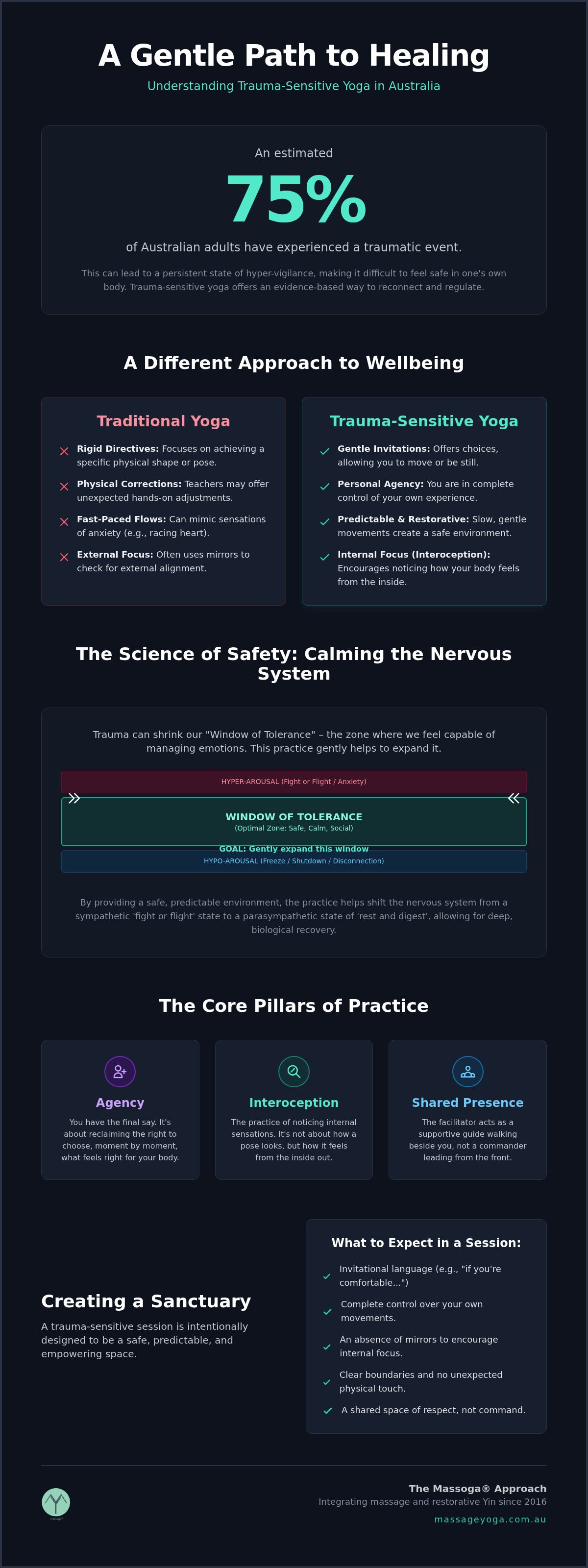
Did you know that an estimated 75% of Australian adults have experienced a traumatic event in their lifetime? This staggering reality often manifests as a persistent hum of hyper-vigilance, making it difficult to find safety in traditional exercise spaces or even within your own skin. If you've felt an inability to switch off or a deep disconnection from your physical self, trauma sensitive yoga Australia offers a gentle, evidence-based path back to yourself. It's a way to acknowledge the body's story without being overwhelmed by it. Soften. Breathe. Arrive.

We recognise that healing is a rhythmic return to your own centre, not a forced destination. This guide will show you how a practice rooted in choice and interoception provides a nurturing way to reconnect with your body and regulate your nervous system. We'll examine how specialised bodywork creates a sanctuary for deep rest, allowing you to move from a state of survival into a soulful, grounded presence. You'll discover how to regain your sense of agency and finally find the stillness you deserve.

Table of Contents

Understanding Trauma Sensitive Yoga in Australia: Beyond the Pose

Healing begins when the pressure to perform ends. For many, a typical yoga class feels like another task to master. You're told where to place your feet, how high to lift your chin, and exactly when to breathe. In the practice of trauma sensitive yoga Australia, these rigid directives dissolve. They are replaced by a series of gentle, soulful invitations. You might choose to move, or you might choose to remain still. Both are equally valid. This practice isn't about achieving a perfect shape; it's about reclaiming the right to exist comfortably in your own body. To truly understand What is Trauma-Sensitive Yoga?, we must look beyond the physical posture and focus on the internal experience of the person on the mat.

For Australians managing high-stress lifestyles or the lingering echoes of past events, this approach is becoming a vital pillar of wellness. It offers a transition from the "doing" of daily life into a state of "being". Facilitators use specific, invitational language like "if you're comfortable" or "when you're ready". This isn't just a polite gesture. It is a clinical necessity that allows the practitioner to lead their own experience, perhaps for the first time in a long time. Soften. Breathe. Arrive.

The Core Pillars of Trauma-Informed Practice

Agency is the heartbeat of this work. It means you have the final say over every movement and every moment. You aren't being "fixed"; you're being supported. Interoception, another vital pillar, encourages you to notice how your body feels from the inside out. Rather than looking in a mirror to check your alignment, you're invited to feel the weight of your heels on the mat or the cool air at the tip of your nose. The facilitator maintains a shared authentic presence, acting as a guide who walks beside you rather than a commander who stands above you. This creates a safe, predictable environment where the nervous system can finally begin to let go.

Why Traditional Yoga Can Sometimes Feel Unsafe

Traditional yoga environments often emphasise physical corrections. A well-meaning teacher might suddenly press on your lower back or adjust your shoulders without warning. For a sensitive nervous system, this unexpected touch can be startling or even triggering. Fast-paced flows can also mimic the physical sensations of anxiety, such as a racing heart or shallow breath, which may accidentally push someone out of their window of tolerance. Trauma-sensitive sessions, such as those offered through Trauma Sensitive Massoga®, remove these triggers. By prioritising the internal state over the aesthetic of the pose, we create a sanctuary where the body is respected, not commanded.

The Science of Safety: How Your Nervous System Finds Rest

When your body remains in a state of hyper-vigilance, it's like a car engine idling at a high RPM even when parked. This persistent state of "on" is often the result of a nervous system that has forgotten how to return to neutral. In the context of trauma sensitive yoga Australia, we use the framework of Polyvagal Theory to understand this phenomenon. Your "Window of Tolerance" is the space where you can manage emotions and sensations without feeling overwhelmed or shut down. Understanding how trauma-informed yoga helps you heal involves gently expanding this window through predictable, sensory-based experiences. By providing a safe environment, we invite the nervous system to down-regulate, moving from a sympathetic "fight or flight" state into a more grounded presence.

Deep rest is not a luxury; it's a biological necessity for emotional and physical recovery. When the body perceives safety, the parasympathetic nervous system takes the lead. This allows your heart rate to slow, your breath to deepen, and your muscles to finally release their protective grip. Without this shift, the body remains in a cycle of stress that can lead to exhaustion and physical discomfort. Soften. Breathe. Arrive.

Integrated Bodywork: The Power of Yin and Massage

While many practices focus solely on movement, the integration of restorative Yin and mindful massage offers a unique sensory reassurance. Yin yoga provides the spaciousness your body needs to feel safe; it allows you to linger in stillness and notice sensations at your own pace. When this is paired with the intentional, consent-led touch of massage, it provides a physical grounding that helps anchor you in the present moment. This combination creates a deeper state of surrender than either discipline could achieve alone, allowing the layers of tension to soften and dissolve. It is a methodical approach to trauma sensitive yoga Australia that prioritises your internal well-being over external form.

Teaching Your Body to Switch Off

True rest isn't just the absence of movement; it's a biological state of safety. For those who feel permanently "on", the transition to a soft exhale requires a slow-paced, intentional rhythm. Every session is designed to lower the heart rate and quiet the mind through consistent, soothing cues. The parasympathetic shift is the biological transition from a state of high-alert survival to a restorative mode where the body's natural healing and digestive processes can finally resume. If you are ready to move away from the noise of daily life, you might choose to begin your own narrative of recovery.

Choosing the Right Support: Trauma-Informed vs. Traditional Yoga

Finding the right support involves more than just looking for a local studio. It's about finding a practitioner who understands the delicate architecture of your nervous system and respects the pace of your healing. Within the context of trauma sensitive yoga Australia, you'll likely encounter two primary terms: trauma-informed and trauma-sensitive. While they sound similar, they represent different levels of care. A trauma-informed approach is a broad framework of awareness that many teachers now adopt. In contrast, a specialised practice of trauma sensitive yoga Australia is a deeply focused session where every element is curated specifically for safety and nervous system regulation. Soften. Breathe. Arrive.

Private sessions are often the preferred starting point for those with sensitive nervous systems. They eliminate the social anxiety found in group settings and allow you to explore movement without the pressure of being observed by others. This one-on-one focus means the facilitator can adjust the session to match your energy levels in real-time. For a more profound shift, luxury retreats offer a total immersion away from the triggers of your daily environment. These experiences allow you to step out of your routine and into a dedicated narrative of recovery, surrounded by nature and professional care.

Questions to Ask Your Facilitator

Before committing to a session, it is wise to establish a sense of trust. Ask your facilitator about their use of invitational language and how they offer modifications for every shape. Enquire about their policy on physical adjustments; a dedicated practitioner will always seek explicit consent before any touch occurs. The physical environment should also be a consideration. Is the space designed to be low-sensory? A sanctuary for healing should be free from the distractions of mirrors or intrusive music, allowing you to focus entirely on your internal state.

The Benefits of a Private Trauma-Sensitive Session

A private session is a bespoke sanctuary. It allows the practice to be tailored specifically to your Window of Tolerance, ensuring you never feel pushed beyond what your body can handle. There is no performance required here. By choosing One on One Massoga® Treatments, you invest in a space where your agency is the guiding principle. This focused attention helps build a bridge back to your physical self, fostering a sense of safety that can eventually extend into your life outside the mat.

Trauma sensitive yoga Australia

Creating a Sanctuary: What to Expect in a Trauma-Sensitive Session

Entering a space for trauma sensitive yoga Australia feels like a soft exhale. It's a sanctuary designed to quiet the external world so you can finally listen to your internal one. Unlike traditional studios, there are no mirrors to invite judgement. The lighting is dimmed. The music is a low, steady hum rather than a distraction. Every bolster, blanket, and block is placed with intention, offering a physical foundation of safety. You aren't here to be seen; you're here to feel.

Before the practice begins, we sit. We talk. This introductory conversation is the cornerstone of the experience, where we establish boundaries and preferences. You might choose to avoid certain areas of the body or opt-out of touch entirely. This isn't just a formality; it's the moment you reclaim your agency. By choosing a dedicated environment for trauma sensitive yoga Australia, you are choosing a space that prioritises your internal safety over external form. The flow of the practice itself is methodical. Movements are slow. Holds are long. Throughout the session, you'll receive constant invitations to choose how you move or where you rest. Massage is offered as a gentle invitation, never an obligation, ensuring you remain the architect of your own healing.

Preparing Your Mind and Body for Rest

Arriving at your session with an intention of self-compassion is the first step toward surrender. Wear something that makes you feel secure and physically comfortable, perhaps loose layers that allow for easy movement. Remember that in this space, "doing nothing" is often the most productive part of the practice. It is in the stillness that the nervous system begins to reset, moving away from the noise of daily life and into a state of deep presence. Soften. Breathe. Arrive.

The Sensory Experience of Massoga®

In a restorative Yin shape, the feeling of being completely supported by props allows your muscles to let go of their protective grip. As you settle into a deep hold, the grounding sensation of hands-on massage provides a sensory anchor, reminding your body that it is safe to rest. Learn more about the science of deep rest and how this unique combination of disciplines supports your recovery by lowering the heart rate and building trust through a consistent, soothing cadence.

Surrendering to Rest: The Massoga® Approach to Trauma-Informed Healing

Since 2016, Massoga® has curated a unique methodology that transcends the typical Australian studio experience. It is a practice born from a deep understanding of the human condition and the necessity for true, uninterrupted rest. While many approaches to trauma sensitive yoga Australia focus purely on clinical protocols, we believe in the restorative power of sensory immersion. Our approach is a soulful integration of Yin yoga and massage, designed to guide you through the transition from the frantic busyness of daily life into a state of profound surrender. Soften. Breathe. Arrive.

This sanctuary was built with a specific philosophy in mind: supporting "The Woman Everyone Depends On". You are likely the one who organises the lives of others, who carries the weight of responsibility, and who rarely finds a moment where someone isn't asking for your time. You deserve a space where no one depends on you. In our sessions, the only requirement is your presence. We provide the safety and the structure so that you can finally let go of the need to manage, protect, or perform. This is your time to be held, rather than doing the holding.

A Sanctuary for the Senses

Our luxury retreats are the ultimate expression of this philosophy. By choosing locations like Magnetic Island, we provide a physical boundary between you and your daily triggers. Seclusion and silence are powerful allies in the healing journey. They allow the nervous system to settle in a way that is rarely possible in a domestic or urban setting. We organise every detail of your stay, from the soothing environment to the rhythmic flow of the sessions, ensuring your only focus is the gentle rise and fall of your breath. This total restoration is a vital part of trauma sensitive yoga Australia, offering a depth of peace that lingers long after you return home.

Your Invitation to Begin

You are ready for this journey exactly as you are today. There is no need to wait until you feel "better" or more "flexible" to seek support. Healing is a methodical return to your own centre, and it begins with the simple choice to prioritise your own well-being. Choosing a path that feels like a soft exhale is the kindest thing you can do for your nervous system. We invite you to step away from the noise and into a narrative of self-care and discovery. It is time to reclaim your peace and rediscover the safety of your own skin.

Reclaim Your Sanctuary and Your Peace

Reclaiming your sense of self starts with a single, gentle choice. We've explored how trauma sensitive yoga Australia provides the necessary framework for nervous system regulation, moving you away from hyper-vigilance and into a state of deep, soulful presence. By prioritising agency and interoception, you can begin to trust your body's signals once more. It's about moving from survival into a soft, steady rhythm of rest.

Since 2016, founder Wallis Murphy-Munn has refined a bespoke integrated bodywork approach that offers far more than a standard class. It is a dedicated path to wellness. Whether you choose private sessions or our luxury retreats designed for deep sensory immersion, you'll find a space where you don't have to perform. You only have to be. This is your invitation to transition from the noise of daily life into a state of total surrender.

Your journey toward stillness is waiting. Arrive exactly as you are and let the healing begin.

Frequently Asked Questions

Is trauma-sensitive yoga different from regular yoga?

Yes, it differs significantly from traditional classes. While regular yoga often focuses on physical alignment and teacher-led directions, trauma sensitive yoga Australia prioritises your internal experience and agency. There are no physical adjustments without consent, and every movement is an invitation rather than a command. This shift allows you to explore sensation at your own pace, ensuring you remain in total control of your body throughout the entire practice.

Do I need a diagnosis of PTSD to attend a trauma-sensitive session?

You don't need a clinical diagnosis of PTSD to benefit from these sessions. This practice is designed for anyone who feels disconnected from their physical self or finds it difficult to switch off from daily stress. Many Australians live with high levels of hyper-vigilance or persistent personal stressors. If you're seeking a space that respects your boundaries and supports your nervous system, you're in the right place. Arrive exactly as you are today.

How does massage integrate with yoga in a trauma-informed way?

Massage is integrated as a grounding sensory anchor during restorative Yin shapes. In a trauma-informed setting, touch is never forced or unexpected; it's a gentle, consent-led invitation that helps you feel supported and present. This combination of stillness and tactile reassurance provides a deeper state of surrender, allowing the body to move out of its protective grip and into a state of restorative safety. It's a rhythmic return to your centre.

Can I choose not to be touched during a Massoga® session?

Absolutely. Your agency is the most important element of the practice. At the beginning of every Massoga® session, we have an introductory conversation to establish your boundaries and preferences. If you prefer not to be touched, that choice is fully respected and honoured. You remain the architect of your own experience, and you can change your mind at any point. Your comfort and sense of security are our primary concerns.

What should I wear to a trauma-sensitive yoga retreat in Australia?

Choose clothing that makes you feel both physically comfortable and secure. We recommend wearing loose, soft layers that allow for easy movement without feeling exposed. Consider bringing a warm pair of socks and a jumper, as your body temperature often drops during deep rest. When you feel physically safe in your attire, it's much easier for your mind to let go and transition into a state of deep presence and surrender.

How do I know if a yoga retreat is truly trauma-informed?

Look for a retreat that emphasises choice-based language and a low-sensory environment. A truly trauma-informed space will avoid mirrors, loud music, and "pushing through" narratives. Facilitators should be open about their background and how they handle physical touch. Since 2016, we've focused on creating luxury retreats that prioritise these pillars, ensuring every guest feels seen and cared for rather than just being a client in a class.

Is trauma-sensitive yoga suitable for beginners?

Yes, it's perfectly suited for beginners. There's no requirement for previous yoga experience or a certain level of flexibility. Because the focus is on internal sensation rather than achieving a specific pose, you can't get it "wrong." This makes trauma sensitive yoga Australia a welcoming entry point for those who might feel intimidated by traditional studio environments. It's a gentle invitation to explore movement without any pressure to perform.

What are the long-term benefits of a restorative yoga practice?

Long-term practice helps regulate the nervous system and expands your "Window of Tolerance." Over time, you may find it easier to manage stress and regain a sense of agency in your daily life. Regular immersion in deep rest encourages the body to move more fluidly between states of activity and relaxation. It fosters a lasting sense of internal safety, allowing you to live with more presence and less hyper-vigilance in the world.


Comments


Written by Wallis Murphy-Munn

Wallis Murphy-Munn is the founder of Massoga®, a unique practice that combines the therapeutic benefits of massage with the restorative elements of Yin Yoga.


Her hands-on teaching approach has led to deeper relaxation for her students, inspiring the creation of Massoga®.


In addition to her practice, Wallis enjoys writing blog articles to share her insights, advocating for the importance of human touch and simple connections in an increasingly isolated world.

14.png

About

Yoga Retreats

Other Services 

  • Instagram
  • Facebook
  • LinkedIn

We acknowledge the traditional owners of the land in all the regions of the beautiful countries we travel to and experience on retreat. The custodians of Kulin Nation, in the regions of the Woiworung, Boonwurrung and Wathaurong People. The custodians of the Yunbenun of the Wulgurukaba People. We acknowledge their Ancestors past, present and future who nurtured and cared for Country for tens of thousands of years.

© 2025 Massoga® Massage Yoga | Website by Insight Culture

bottom of page