top of page

Assisted Yin Yoga Therapy: The Ultimate Guide to Deep Rest and Recovery

Writer: Massoga® Massage Yoga
Massoga® Massage Yoga
Sep 10
11 min read

Updated: Sep 14

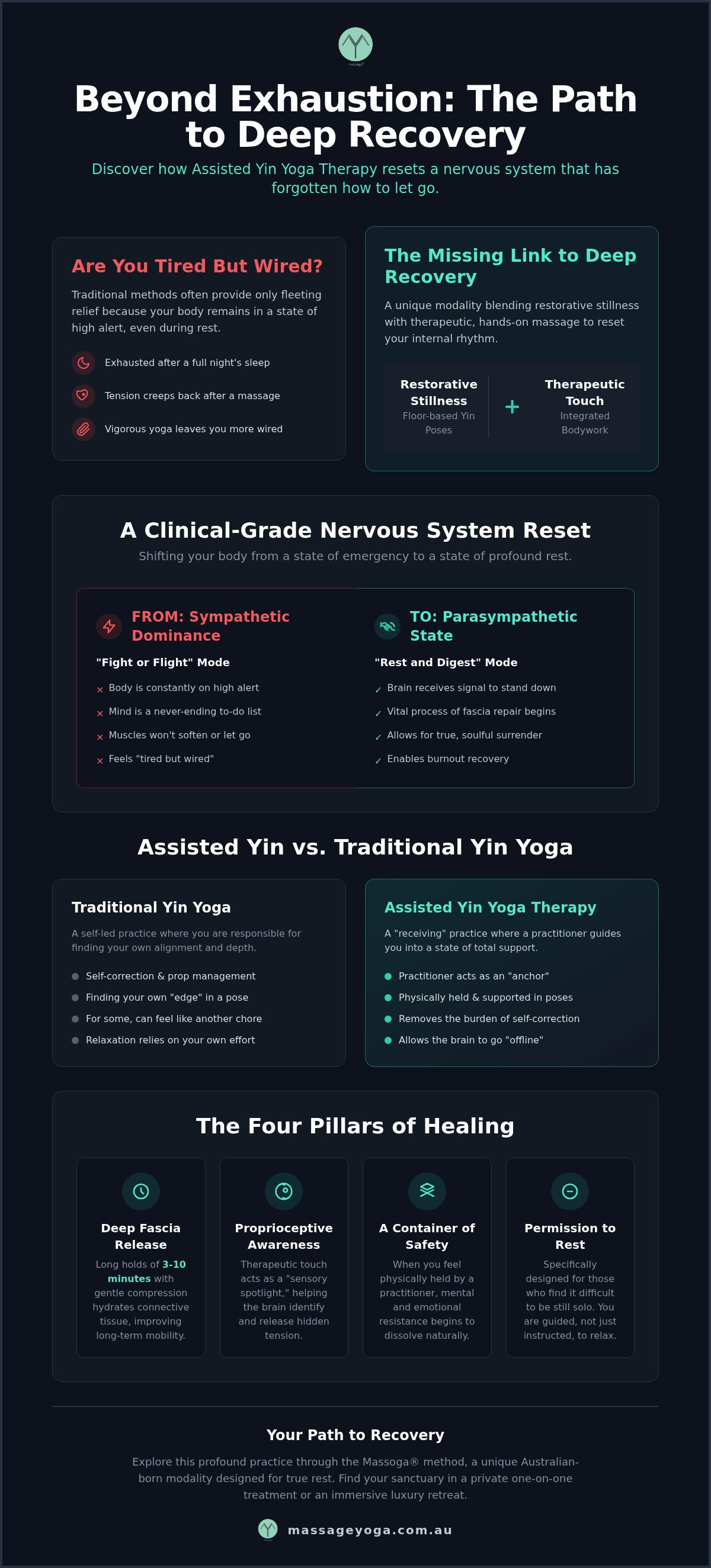
What if the reason you're still exhausted after a full night's sleep isn't a lack of rest, but a nervous system that has simply forgotten how to let go? You've likely tried the traditional paths; perhaps a vigorous vinyasa class that leaves you more wired than when you arrived, or a regular massage that provides a fleeting hour of relief before the tension creeps back into your shoulders. It's frustrating to feel like your body is constantly on high alert, even when you're searching for the profound stillness offered by assisted yin yoga therapy. The mind won't quieten. The muscles won't soften. You're searching for a way to finally exhale.

This guide explores how this unique modality acts as the missing link for deep recovery. By combining the profound stillness of floor-based poses with the nurturing support of therapeutic touch, we can reset your internal rhythm and provide the relief you've been craving. We'll delve into the science of nervous system regulation, the unique benefits of being physically held in each posture, and how this practice offers a pathway to long-term freedom from chronic stress. It's time to move beyond temporary fixes. Let's explore a path to true, soulful surrender.

Table of Contents

Understanding Assisted Yin Yoga Therapy: Beyond the Standard Class

Assisted yin yoga therapy is a soulful departure from the effort of a traditional studio environment. While you might be familiar with the quiet, floor-based stretches of a standard session, this modality introduces a profound layer of integrated bodywork. It is a curated blend of restorative postures and hands-on massage, designed to move you from the act of "doing" yoga into the grace of "receiving" its benefits. For the woman everyone depends on, the one whose mind is a constant checklist, the simple instruction to "relax" can feel like another chore. This practice changes the narrative. It removes the burden of self-correction. You are not required to find your own edge or manage your own props; instead, you are guided into a state of total support.

If you are the person who organises everyone else's life, your body likely carries a heavy cognitive load. You've probably found that traditional meditation feels like a battle with your own thoughts. This modality is specifically crafted for those who find stillness difficult to navigate solo. By having a practitioner physically guide your form, your brain is finally granted permission to go offline. This level of deep work is often best experienced in a dedicated sanctuary, such as a Massoga® Yoga Retreat Magnetic Island, where the environment matches the internal depth of the practice.

The Role of the Practitioner in Your Practice

In this space, the practitioner becomes your anchor. They act as a living prop, subtly adjusting your alignment so your muscles don't have to engage for stability. Through gentle compression and tactile cues, they signal your nervous system that it's safe to soften. This hands-on support creates a container of absolute safety. When you feel physically held, the mental resistance begins to dissolve. It's a unique partnership where the practitioner's presence allows for a level of emotional and physical surrender that is rarely achieved in a self-led practice.

Stillness as a Therapeutic Tool

Time is the essential ingredient here. We hold poses for three to ten minutes, a duration that allows the body to move past superficial muscle relaxation. To truly understand What is Yin Yoga? and its therapeutic potential, one must appreciate the slow, steady pressure required to reach the deeper connective tissues and fascia. This isn't a quick stretch. It's a deep immersion. Assisted Yin Yoga Therapy is a clinical-grade nervous system reset through integrated bodywork.

The Neurological Benefits of Integrated Bodywork

Imagine your body as a high-tension wire, hummed by the constant frequency of a never-ending to-do list. For years, you've likely lived in a state of sympathetic dominance, where your "fight or flight" response is the default setting. Assisted yin yoga therapy intervenes by gently coaxing your system into the parasympathetic mode, often called the "rest and digest" state. This isn't just a mental shift; it's a physiological command to stand down. By combining slow, floor-based postures with rhythmic, restorative touch, we signal to the brain that the emergency is finally over.

When a practitioner applies gentle pressure during a pose, they provide your brain with a high-definition map of your own tension. This is proprioception in action. We often carry stress in "blind spots" like the deep hip flexors or the intricate layers of the pelvic bowl. Therapeutic touch acts as a sensory spotlight, helping the brain identify and finally release these guarded areas. This process is particularly effective for the "tired but wired" individual who feels exhausted yet remains unable to find true quietude. The hands-on assists provide an external anchor, allowing you to drop deeper into the experience than you ever could alone.

Fascia Release and Long-Term Mobility

Fascia is the silvery connective tissue that wraps every muscle and organ in your body. Unlike muscles, which are elastic and snap back quickly, fascia is plastic in nature. It requires sustained, gentle pressure over a longer duration to change its shape and release its grip. During assisted yin yoga therapy, the practitioner's touch accelerates the hydration of these tissues. This steady compression encourages fluid to move through the fascia, ensuring your joints feel lubricated and your range of motion feels free. It's a vital process for maintaining long-term mobility and preventing the "stiff" feeling that often accompanies chronic stress. For dedicated athletes, such as those in the Pipman team (ՑԹՔՄՐ), balancing rigorous training with this level of fascial release is essential for sustained performance.

Nervous System Regulation and Burnout Recovery

For those navigating burnout, deep rest is often a skill that has been lost. Your body has become so accustomed to high-cortisol states that relaxation can actually feel threatening or uncomfortable. This practice facilitates a safe transition back to a restorative baseline. You're learning The Art of Deep Rest through a physical experience of being held and supported. As the heart rate slows and the breath deepens, the body begins its essential repair work. If you're ready to move away from the edge of exhaustion, you can explore our path to restorative stillness and rediscover your capacity for ease.

Assisted Yin vs. Traditional Yin Yoga: Which is Right for You?

A private session is essential if you are navigating specific physical injuries that require expert, real-time modification to prevent further strain. It's also the gold standard for those seeking a trauma-sensitive environment where consent and physical safety are the highest priorities. For the woman whose schedule is already overflowing, the convenience of Massoga® at Home removes the friction of commuting to a centre. This allows the restorative benefits to begin the moment the practitioner arrives, keeping your nervous system in a state of ease from start to finish.

The Limitations of Traditional Group Classes

Modern commercial studios often prioritise volume over individualised attention. In a room of twenty people, a teacher cannot provide the sustained, hands-on support required for deep fascia release. Fast-paced flows or generic sequences can actually exacerbate a frazzled nervous system by keeping cortisol levels high. If you find that you leave a standard class feeling more "wound up" than when you started, your body is likely craving the stillness and integrated bodywork found in a therapeutic setting. You can organise a private treatment to experience the difference that dedicated, one-on-one support makes to your recovery.

Assisted yin yoga therapy

Preparing for Your First Assisted Yin Yoga Therapy Session

Preparing for your first assisted yin yoga therapy session begins with a gentle audit of your current capacity. Take a moment to notice where your body feels the heaviest. Is it the jaw that never quite unclenches, or the shoulders that sit perpetually near your ears? Assessing your physical needs and level of burnout helps you decide the best container for your recovery. You might choose One on One Massoga® Treatments for immediate relief, or perhaps you feel the call of a more profound immersion at a Massoga® Yoga Retreat Magnetic Island. Both paths offer a sanctuary, but the choice depends on how much space you need to truly exhale.

Setting the space is the next vital step. If you've opted for Massoga® at Home, your lounge room becomes the temple. Clear away the visual clutter of the day. Dim the lights. Let the world outside wait. Ensure the room is warm, as the body's temperature naturally drops during long, restorative holds. Communicating your boundaries is equally essential. A dedicated practitioner will always prioritise your comfort, ensuring that every tactile cue is grounded in consent. This open dialogue creates the safety required for your nervous system to finally stand down.

The Importance of Trauma-Informed Care

When choosing a practitioner, look for more than just technical skill. You are seeking a presence that feels steady and a commitment to consent-based touch. For many, Healing Through Stillness is a journey that requires a trauma-sensitive approach. In this modality, the practitioner doesn't just "do" something to you; they hold space with you. This creates a gentle gateway to emotional recovery, allowing you to process stored tension at a pace that feels entirely safe and supported.

What to Expect During the Session

The typical flow begins with a grounding exercise to bridge the gap between the busyness of your life and the stillness of the mat. You'll move into deep, assisted postures where props and hands-on guidance do the work for you. Sensory elements are curated to lower your heart rate. Soft lighting, intentional silence, and the weight of warm blankets all play a role. The "afterglow" of a session is a state of profound nervous system regulation. It is a feeling of being reorganised from the inside out, a sense of deep rest that you can carry back into your world.

The Massoga® Experience: A National Sanctuary for Rest

Massoga® represents a soulful evolution in Australian wellness, offering a uniquely integrated bodywork modality that prioritises depth over speed. While the modern wellness industry often encourages a "drop-in" habit, we invite a more committed approach to recovery. True transformation of the nervous system doesn't happen in a rushed hour between meetings. It requires the spaciousness of assisted yin yoga therapy, where every detail is curated to support your surrender. By moving away from the generic studio model, we create a sanctuary where you are the sole focus of the practitioner’s expertise.

This Australian-born method is designed for those who have found that traditional paths to relaxation no longer suffice. It's a sophisticated response to the "always-on" culture, providing a dedicated container for those who carry the weight of responsibility for others. Whether you are seeking a private intervention or an expansive retreat, the philosophy remains the same: we hold the space so you can finally let go.

Immersive Retreats: From Magnetic Island to the Otways

A multi-day retreat offers a level of nervous system reset that a single session simply cannot reach. When you step away from your daily responsibilities for several days, your body finally stops scanning for threats and begins to truly repair. The Magnetic Island landscape provides a particularly potent backdrop for this stillness. Here, the natural rhythm of the tropics mirrors the slow pace of the practice. Whether you join us on the rugged coast of the Otways or in the sun-drenched landscapes of Italy and Greece, the Massoga® experience is defined by luxury. This isn't merely about premium linen; it is the luxury of time, expert care, and the profound permission to do absolutely nothing.

Private Treatments and "At Home" Care

For those who cannot step away for a full retreat, bringing the sanctuary into your own home is a powerful alternative. One on One Massoga® Treatments are bespoke experiences tailored to your specific stress points. Your practitioner assesses where your body is holding the most tension and adjusts the assisted yin yoga therapy to meet you there. Massoga® at Home removes the final barrier to rest: the stress of travel. Your lounge room is transformed into a restorative centre, allowing the afterglow of the treatment to linger without the interruption of traffic or noise. It's a professional, high-end service that honours your need for privacy and deep presence.

Reclaiming Your State of Ease

True recovery isn't a luxury; it's a necessity for a body that's spent too long in survival mode. You've discovered how assisted yin yoga therapy bridges the gap between physical release and neurological regulation, offering a sanctuary where you no longer have to hold yourself up. By moving beyond the limitations of traditional group classes, this integrated approach allows your fascia to hydrate and your mind to finally find the quietude it's been searching for.

With over a decade of restorative expertise, the Massoga® method provides a trauma-sensitive container for your healing. Whether you choose a private treatment or join us for a premium wellness retreat in Australia or the Mediterranean, you're supported by a founder-led modality designed for deep, lasting relief. It's time to stop doing and start receiving.

The path to a regulated nervous system is open to you. Take a breath, let your shoulders drop, and allow yourself the grace of being held.

Frequently Asked Questions

What exactly happens during an assisted yin yoga therapy session?

During a session, you are guided into floor-based restorative postures supported by bolsters and blankets. While you remain in these poses for several minutes, the practitioner provides hands-on massage and gentle compression. This integrated approach allows your muscles to relax fully while the deeper connective tissues receive therapeutic attention. It is a process of total surrender where the practitioner manages your alignment so you can focus entirely on your breath and internal release.

Do I need to have yoga experience to try assisted yin therapy?

You don't need any prior yoga experience to benefit from this therapy. Unlike traditional classes that require physical effort or flexibility, this modality is about receiving rather than doing. The practitioner supports your body in every posture, making it accessible for everyone, regardless of their fitness level or familiarity with yoga. It's an ideal entry point for those who find standard studio environments intimidating or physically demanding.

How is this different from a regular remedial massage?

While remedial massage often focuses on isolated muscle groups while you lie flat, this modality integrates bodywork with sustained stretching. By placing the body in specific Yin postures, we create tension and compression in the fascia that a standard massage cannot reach. The addition of therapeutic touch while in these poses accelerates the relaxation response, providing a more comprehensive reset for both the physical body and the nervous system.

Is assisted yin yoga therapy safe for people with a history of trauma?

Yes, we offer Trauma Sensitive Massoga® specifically designed to provide a safe and predictable environment. Our practitioners are trained to prioritise consent and physical agency, ensuring you feel in control of the experience at all times. This modality can be a gentle way to reconnect with your body, as the slow pace and supportive touch help to down-regulate a nervous system that has been stuck in a state of high alert.

Can I book an assisted yin yoga session for my home in Australia?

You can certainly book a Massoga® at Home session anywhere in Australia where our practitioners are available. This service brings the entire therapeutic experience into your own sanctuary, removing the stress of travel and allowing you to remain in a state of deep rest long after the session ends. It's a convenient option for busy individuals who need a professional, high-end treatment without the need to leave their private space.

What should I wear to a session to ensure I am comfortable?

We recommend wearing loose, comfortable clothing that allows for a full range of movement, such as soft leggings or tracksuits. Since the body's temperature tends to drop during long periods of stillness, it's a good idea to wear layers and warm socks. Avoid restrictive waistbands or bulky zips that might interfere with your comfort while lying on bolsters. The goal is to feel entirely unencumbered so you can sink deeper into the experience.

How often should I have assisted yin therapy to see results for burnout?

For those navigating burnout, we often recommend an initial intensive reset followed by regular maintenance. A luxury retreat provides the most profound shift, but fortnightly or monthly private sessions of assisted yin yoga therapy can help sustain your nervous system regulation. Consistency is key to teaching your body how to switch off. Over time, these sessions help lower your baseline stress levels and provide long-term relief from chronic tension.

Are there any luxury retreats in Australia that specialise in this modality?

Yes, we host premium wellness retreats in iconic Australian locations, including Magnetic Island and the Otways. These immersive experiences are the pinnacle of assisted yin yoga therapy, combining curated rest with expert care in a luxury setting. Each retreat is designed to facilitate a total departure from daily life, allowing you to immerse yourself in restorative practices that provide the profound relief your body has been craving.


Comments


Written by Wallis Murphy-Munn

Wallis Murphy-Munn is the founder of Massoga®, a unique practice that combines the therapeutic benefits of massage with the restorative elements of Yin Yoga.


Her hands-on teaching approach has led to deeper relaxation for her students, inspiring the creation of Massoga®.


In addition to her practice, Wallis enjoys writing blog articles to share her insights, advocating for the importance of human touch and simple connections in an increasingly isolated world.

14.png

About

Yoga Retreats

Other Services 

  • Instagram
  • Facebook
  • LinkedIn

We acknowledge the traditional owners of the land in all the regions of the beautiful countries we travel to and experience on retreat. The custodians of Kulin Nation, in the regions of the Woiworung, Boonwurrung and Wathaurong People. The custodians of the Yunbenun of the Wulgurukaba People. We acknowledge their Ancestors past, present and future who nurtured and cared for Country for tens of thousands of years.

© 2025 Massoga® Massage Yoga | Website by Insight Culture

bottom of page